|
Europe >
England > London
> Hampton Court Palace > Great Vine
The Great Vine
From:
Hampton Court Palace
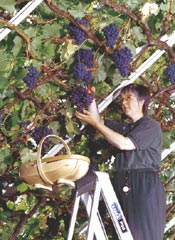
ABOVE: Grapes are harvested from the Great
Vine for sale in the Hampton Court Palace shops.
The Great Vine in
the Hampton
Court Palace Gardens is the oldest and largest known vine in the world. Here's what the
palace staff have to say about this remarkable grapevine:
-
The
Great Vine is more than 230 years old and 36.5 meters (120 feet) long. It is
believed to have been planted by Lancelot "Capability" Brown around 1768, during
his time as Surveyor to George III's Gardens and Waters. The vine is also the
oldest plant in the palace gardens, having come from a small cutting at
Valentine's Park in Essex (which no longer survives).
-
The Great
Vine was first planted in a glasshouse built to house Queen Mary's collections
of exotics from the tropics. Its roots were planted outside, and its branches
were trained inside the glasshouse, which measured 18 by 4 meters (60 by 13
feet). By the 1790s, the vine was thriving so much that the glasshouse had to be
lengthened by a further 3.5 meters or 11½ feet.
-
In 1800, the girth of the trunk was 330 mm or about
1 foot. In 1887, it was already 1.2 meters or 4 feet around the base; today, it
measures 3.65 meters or 12 feet around the base. Its longest rod is 36.5 meters
or 120 feet.
-
The current aluminum Vine House was built in
1969. It incorporates wrought-iron Victorian supports. The rebuilding was unique
as it was the first time a glasshouse was built around a plant. Both the frame
that supports the Vine and the viewing gallery (still used by the general
public) come from a 19th Century wooden vine house.
-
The Vine was
first shown to the public in the 1840s when Queen Victoria opened the gardens to
the public.
-
The Vine usually blossoms in early May with small and
fragrant flowers.
-
The crop is usually harvested in September. It
takes the Vine Keeper around three weeks to remove all the grapes. The crop
averages 500 to 700 bunches of grapes that weigh 220 to 320 kg (507 to 705 lb).
The largest recorded crops of grapes from the Vine were 1,800 bunches in 1798
and 2,245 bunches in 1807.
-
The grapes, which are black and sweet,
have always been used by the Royal household as dessert grapes. In 1930,
however, George V started sending the grapes to hospitals, and within five years
they were being sold to palace visitors. Today, the full crop of black eating
grapes is sold to visitors in the palace shops in late summer or early autumn.
-
In 1933, the grapes were 6 shillings per pound. A shilling
of this went towards the baskets in which they were sold. These baskets were
specially made by soldiers blinded in the First World War.
Back to:
Hampton Court Palace
Text and photo copyright © HRP. Used by permission.
| |
|