| Home | Main Menu |
|
|
Tower of London
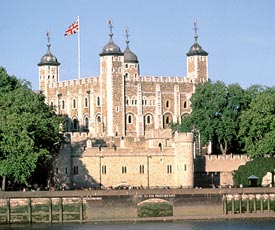
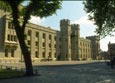
ABOVE: The Tower of London, viewed from the River Thames. INSET BELOW: A Yeoman Warder describes dramatic scenes from the Tower's history.
Fortunately, the nearly 1,000-year-old castle has plenty of room for crowds, with 18 acres (7.3 hectares) of towers, walls, and green space overlooking the banks of the River Thames. An eight-year, £20 million restoration and improvement project has made this UNESCO World Heritage Site even more attractive, accessible, and convenient for visitors. The Tower of London is operated by Historic Royal Palaces, a Royal Charter Body that also manages Hampton Court Palace, Kensington Palace, Kew Palace, and the Banqueting House in Whitehall. Capsule history:
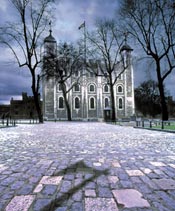
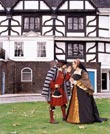
ABOVE: The shadow of the axe falls before the White Tower, which was begun in 1077 and finished 20 years later. INSET BELOW: Tudor reenactment near the Queen's House on Tower Green. The Tower of London's history can be traced back to 1067, when William the Conqueror ordered a wooden fortress built along the Thames to keep Londoners from rebelling against their Norman occupiers. Ten years later, work began on the White Tower, a stone keep built atop ruins of Roman fortifications.
The Tower is perhaps best known as a prison, a role that it served from the beginning of the 11th Century until the early years of World War II. It has also housed the Royal Mint, a menagerie, an armory, and the Crown Jewels. Since World War II, the Tower of London has been open to the public as an historic site and a tourist attraction. Famous prisoners:
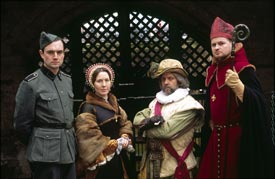
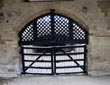
ABOVE: Actors portray inmates at the Traitors' Gate, the Tower's main entrance on the Thames. Left to right: A German WWII prisoner, Ann Boleyn, Sir Walter Raleigh, and Bishop Ranulf Flambard. The Tower of London was the celebrity prison of medieval and Tudor times, attracting a better class of inmate than your common-garden dungeon or gaol. The Tower's first prisoner (and escapee) was Bishop Ranulf Flambard, who received Concierge Floor treatment in the White Tower after being imprisoned by Henry I in 1100. The bishop subsequently hosted a party his guards, then slithered down a rope and escaped in a waiting boat while they were drunk. Sir Walter Raleigh inhabited the Garden Tower (a.k.a. the Garden Tower) for 13 years with his wife and children as companions. Raleigh, who is said to have taught Queen Elizabeth I how to smoke, raised grew tobacco on Tower Green when he wasn't occupied with writing The History of the World. Guy Fawkes, whose role in the Gunpowder Plot is still commemorated with bonfires and fireworks, was interrogated in the tower before being hung, drawn, and quartered at Westminster. Lord Nithsdale earned "famous prisoner" status as the Tower's first and only cross-dressing escapee. On the eve of his scheduled execution, his wife and two servants brought him a disguise of women's clothing. (See our short piece on Lord Nithsdale's escape.) The Tower continued to be used as a prison during two World Wars, and the presence of German soldiers and spies in the Tower may well have protected it from bombing. The most famous German prisoner was Rudolf Hess, the Deputy Führer of the Third Reich, who spent five days in Queen's House after flying from Germany to Scotland in May, 1941. Executions:Contrary to popular belief, only a small number of executions have taken place within the Tower of London. Most condemned prisoners were taken to Tower Hill or other places in London for beheading or to be hung, drawn, and quartered. Six beheadings have occurred on Tower Green. Anne Boleyn, the second wife of Henry VIII, was executed by a French swordsman in 1536; Catherine Howard, Henry's fifth wife, lay her head on the block in 1542. Lady Jane Grey, who reigned as Queen for only nine days in 1553, died by the axe in 1554 for "usurping the throne of England." Less famous victims were Margaret Plantagenet Pole, the 68-year-old Countess of Salisbury, who refused to go quietly and required several blows of the axe to die in 1541. The last prisoner to beheaded at the Tower was Robert Devereux, Earl of Essex, who was arrested after plotting against Queen Elizabeth I in 1601.
The World War I and II executions took place in the Tower's East Casemates Rifle Range. Yeoman Warders ("Beefeaters"):
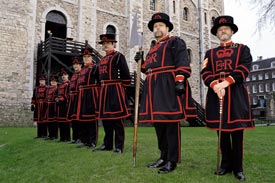
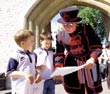
ABOVE: Yeoman Warders with John Keohane (who was Yeoman Gaoler when this photo was taken) and Tom Sharp, Mr. Keohane's predecessor as Chief Yeoman Warder. INSET BELOW: A Yeoman Warder gives directions to young visitors.
In addition to keeping an eye on the Tower, the Yeoman Warders lead free tours and answer questions for visitors. Sample Q&A:
The Yeoman Warders also have ceremonial duties, including the nightly Ceremony of the Keys (see below) and attending such events as royal coronations and the Lord Mayor's Show in the City of London. Natasha Woollard of the Tower's press office and John Keohane, the Yeoman Gaoler during my visit, were kind enough to supply a number of facts about the Yeoman Warders:
The Yeoman Warders have two uniforms:
Sites and sights:
ABOVE: Two of Henry VIII's wives, Anne Boleyn and Catherine Howard, were beheaded on the scaffold site at the Tower of London. INSET BELOW: Traitors' Gate; prisoners' inscriptions at Beauchamp Tower. The easiest way to get your bearings (along with an understanding of the Tower and its history) is to join a Yeoman Warder tour, which is certain to be both informative and entertaining. After that, you can wander about the Tower's grounds on your own, allowing time for such attractions as:
Crown Jewels:
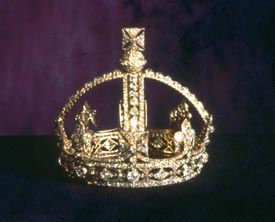
ABOVE: Queen Victoria's Small Diamond Crown measures 3.7 inches (9.9 cm) high and 3.4 inches (9 cm) in diameter. It was worn atop a widow's cap. The crown was made in 1870, using some 1,300 diamonds from a large necklace and other jewelry in the Queen's personal collection. INSET BELOW: The Jewel House has been located in Waterloo Block since 1994. Keith Hanson is Chief Exhibitor of the Crown Jewels, having been appointed to that post in 2000 after serving as a Yeoman Warder. Hanson, who lives at the Tower with his wife Angela, is the latest in a long line of Englishman who have watched over the royal Regalia since the Crown Jewels were first displayed to the public at the Tower of London in 1661 (and possibly earlier).
There, you'll step onto a moving walkway that slowly takes you past well-lit display cases that hold the Imperial State Crown, Queen Victoria's Small Diamond Crown (see photo above), the Imperial Crown of India, and other precious items. The jewels are dazzling (literally as well as figuratively) in the otherwise darkened room. Once you've stepped off the moving walkway, you can return to the head of the display cases and repeat the process on the other side, or you can climb a few steps to a viewing platform that offers a different perspective on the collection. Next, continue to the next room where you can see Queen Elizabeth II's Coronation Robe and other gear. (Film footage of the Queen's coronation ceremony on June 2, 1953 is shown continuously on high-definition TV screens.) Some of the items to look for during your visit include:
Here are more facts about the Crown Jewels, compliments of the Tower's press office and the Chief Exhibitor:
The Tower Ravens:
ABOVE: The Tower's former Raven Master, Derrick Coyle, with one of his charges. INSET: A bird poses for tourists. Nobody knows when ravens first came to the Tower of London, but they've been associated with the Tower for centuries. Legend dictates that, if the ravens ever leave, the Tower will fall and the Kingdom will fall, so Charles II decreed that there must always be at least six ravens at the Tower. That tradition has been honored for more than 300 years.
(The information above was supplied by the Tower's press office, whose staff are on good terms with their feathered colleagues.) Ceremony of the Keys:
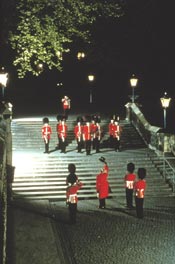
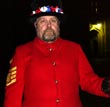
ABOVE: Conclusion of the nightly ceremony. INSET BELOW: Chief Yeoman Warder in ceremonial uniform with Tudor-style hat. For more 700 years, the Gentleman Porter or (in more recent times) the Chief Yeoman Warder has has locked the Tower's heavy wooden gates each night with a set of heavy keys.
The Yeoman Warders take great pride in the fact that the Ceremony of the Keys continued without interruption even when several German bombs fell on the Tower in World War II. (After a direct hit in September, 1941, the ceremony was delayed by half an hour but went ahead after the dust and smoke had settled.) It's worth noting that the Ceremony of the Key isn't just for show: As the Tower's press office points out, "The importance of securing this fortress for the night is still very relevant, because although the monarch no longer resides at this royal Palace, her crown jewels do!" How to observe the ceremonyAnyone can witness the Ceremony of the Keys, which normally is open to the public every night of the year. However, tickets--which are free--must be obtained in advance by booking online. (The ceremony is extremely popular, so we recommend booking months ahead.) What you'll seeOn the night of the ceremony, you'll be admitted to the Tower at 9:30 p.m. precisely and escorted to a spot near the Bloody Tower. A Yeoman Warder will tell you how to behave (no talking, no photos), and at 9:53 p.m. the Chief Yeoman Warder will approach with the Keys of the Tower in one hand and a brass lantern in the other. He'll collect his escort from the military guards and proceed to the entrance to secure the main gates. During the ceremony, the Yeoman Warder will reply to a guard's challenge, and the Ceremony of the Keys will later conclude with a bugle call (see photo at top of page). At 10:05 p.m, you and your fellow visitors will be escorted to the after-hours gate used by the Tower's Yeoman Warders and military guards.
Events and reenactments:
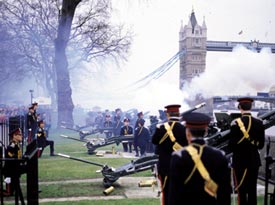
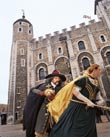
ABOVE: Gun salute by the Honourable Artillery Company, the oldest armed body in Britain. INSET BELOW: Colonel Blood attempts to steal the Crown Jewels. The Tower of London keeps visitors (and Londoners) coming back with seasonal events, historic reenactments, and special exhibitions.
Visitor information:
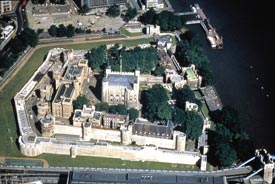
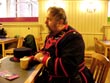
ABOVE: An aerial view of the Tower and the Thames. INSET BELOW: John Keohane, the Chief Yeoman Warder at the time of my visit, enjoyed a cup of tea in the New Armouries restaurant. Opening hours and tickets. The Tower of London is open year-round. Opening days and hours vary according to the season and government public-health guidelines. See "Web information" below to check current times and ticket prices. Transportation. The Tower of London is easy to reach by Underground, bus, or boat. The closest tube station is Tower Hill, which is served by the Circle and District lines.
Shops. Half a dozen shops offer everything from Yeoman Warder-themed souvenirs to armor replicas and Crown Jewels-inspired jewelry. Web information. The Tower of London section of the Historic Royal Palaces Web site is your official guide to the Tower. Another useful resource is Camelot Village: The Tower of London.
Most photos copyright © HRP. Used by permission. |
|
|
| Europe for Visitors - Home | | Contact information, disclosures | Copyright © 1996-2024 Durant and Cheryl Imboden. All rights reserved. |


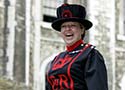 Finally, the first woman
Yeoman Warder (a former Army accountant
named Moira Cameron) began working in uniform at the Tower of London on September 3,
2007.
Finally, the first woman
Yeoman Warder (a former Army accountant
named Moira Cameron) began working in uniform at the Tower of London on September 3,
2007.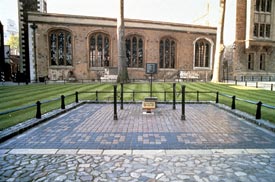
 The
J
The
J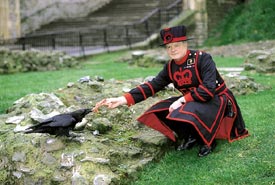
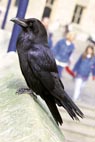 If you're an aficionado of raven trivia, take a moment to
memorize these facts and figures about the Tower's avian mascots:
If you're an aficionado of raven trivia, take a moment to
memorize these facts and figures about the Tower's avian mascots: