| Switzerland & Austria | Europe |
|
Pimsleur Swiss-German
|
| LE |
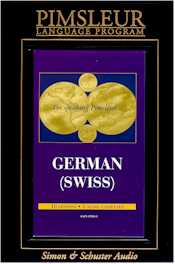
ABOVE: Pimsleur's Swiss-German language course has 10 half-hour lessons. It's published in CD and MP3 formats.
Switzerland has four official languages (German, French, Italian, and Romansh), but the country's dominant language is Schwyzertüüsch or Swiss German--a collection of regional and local dialects spoken by nearly two-thirds of the country's population.
Dialects such as Züritüüsch and B�rndüsch exist side by side with Schweizerhochdeutsch, the Swiss version of standard or High German. German-speaking Swiss typically use dialect at home, at work, in shops, etc., with local radio and TV programs frequently being in dialect as well. Standard German is used in school, in newspapers and magazines, in international business, and for broadcasts such as national news and imported TV shows.
One reason why dialect and standard German coexist is that Swiss German is a spoken language, not a written language (although various ways of spelling Swiss-German words do exist, mainly for use in reference and teaching materials, advertising, and such). If you were a German-speaking Swiss, you'd probably converse with friends and relatives in Swiss-German but send them e-mail or letters in the High German that you learned in school.
For the foreigner, standard or High German will work just fine as a spoken language in the German-speaking cantons. But it can be fun to learn a bit of the local lingo, and it's also convenient to understand a store clerk's request for drisg (30) francs or your hotel receptionist's comment that "Morn isch sch��" ("Morgen ist sch�n," a.k.a. "Tomorrow's weather will be nice."). And you can't help feeling a sense of accomplishment when a passerby asks you the time at 10:30 a.m. and you're able to reply, "Halbi �lfi."
So where can you learn Swiss German? If you have time for an extended visit to Switzerland, you can take a course at a language school. And if you have a good knowledge of standard German, you can buy any number of books and cassette courses from a major Swiss bookstore like Orell Füssli in Zürich. But for most English-speaking tourists, students, or business transferees, the quickest and cheapest introduction to Schwyzertüüsch is Pimsleur's 10-lesson Swiss German language course, which is available as a CD or in MP3 format.
The Pimsleur Method, developed by Dr. Paul Pimsleur, is based on the "principle of anticipation" and "graduated interval recall." In real-life terms, this means two things:
Unlike traditional language-learning methods, the Pimsleur approach doesn't use a textbook. The method is completely aural and oral--you learn by hearing and speaking, as if you were a child. (This makes the course handy for use while driving, walking, or jogging.)
I was a little skeptical of the Pimsleur Method when I tried the course, if only because I like having vocabulary lists and grammar tables in front of me. But after completing the ten lessons, I was surprised by the amount of material that I'd retained. The aural/oral Pimsleur Method seems ideal for a spoken dialect like Swiss German, and I recommend the course highly to anyone who wants to learn the basics of Schwyzertüütsch before visiting Switzerland.
A few quibbles:
Pimsleur
Swiss German
Hear a sample lesson from Pimsleur's CD/MP3 course or order online from Simon &
Schuster.
Schwyzertüütsch
Q: When a Swiss farmer shouts "Grüezi" or "Tschau Z�me"
from his BMW, how should you respond? A: In dialect, if you've
memorized our list of Swiss-German phrases. (Our article includes descriptions of
useful books and other resources.)
About the author:
 Durant Imboden
is a professional travel writer, book author, and editor who focuses on European
cities and transportation.
Durant Imboden
is a professional travel writer, book author, and editor who focuses on European
cities and transportation.
After 4-1/2 years of covering European travel topics for About.com, Durant and Cheryl Imboden co-founded Europe for Visitors in 2001. The site has earned "Best of the Web" honors from Forbes and The Washington Post.
For more information, see About Europe for Visitors, press clippings, and reader testimonials.
|
"Best of the Web"
From Durant and Cheryl Imboden: |
|
| Europe for Visitors - Home | | Contact information, disclosures, audience | Copyright � 1996-2024 Durant and Cheryl Imboden. All rights reserved. |