|
| Venice Home | All topics |
| Where to stay | Transportation |
 Helping
30+ million
Venice travelers since 1997
New in 2024:
Venice's tourist "access fee"
Helping
30+ million
Venice travelers since 1997
New in 2024:
Venice's tourist "access fee"
Helping
30+ million
Venice travelers since 1997
New in 2024:
Venice's tourist "access fee" |
|
Planning Your Trip to VeniceWhen to come, how long to visit, where to stay, how to arrive, and where to find detailed planning advice and information at Veniceforvisitors.com.
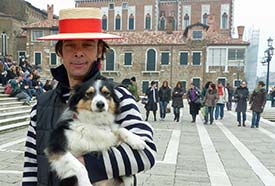
ABOVE: A gondolier and his dog pose by the Basilica di Santa Maria della Salute. When to come
To our way of thinking, the best time for a trip to Venice is from late October into April (excluding Carnival, unless you crave crowds and high prices).
Air fares and hotel prices are lowest in winter--which means you can allocate your travel budget over a longer period and give Venice the time it deserves. See our Venice in Winter article for more advice and photos. How long to visit Venetophiles may consider this next piece of advice to be sacrilege, but here it is:
Still, it's much nicer to spend a few days in Venice--or, preferably, a week or longer. For one thing, opening times (especially out of season) can make it difficult to visit more than a sampling of museums and churches in a day or two. There's a lot to see beyond the usual tourist attractions: e.g., the islands of the lagoon, the ancient Jewish Ghetto, and the bridges, canals, back streets, and shops of neighborhoods that hurried and harried tourists never see. Many sights won't cost you a penny (See our Top 11 Free Sights article for suggestions). Venice is also a convenient hub for day trips to cities and towns throughout the Veneto region, such as Chioggia, Vicenza, Treviso, Padua, and Verona.
Where to stay
For advice on accommodations, see our Venice Hotel Guide and our Number 1 Hotel Warning! How to arrive Don't drive to Venice unless you have to. Parking is expensive, and finding a spot in a garage or outdoor lot can be a nuisance in high season.
For getting around town after you've arrived, see Venice local transportation and Walking in Venice. 
Planning resources If you're planning your first trip to the city, start with Introducing Venice: an orientation for first-time visitors and our Frequently Asked Questions (FAQ). Next, click the links in the table below or consult our Venice articles index. Be sure to read Top 11 Tourist Mistakes in Venice (and how to avoid them).
Finally, if you're a pet aficionado, take a moment to look at our dog blog, Maggie in Venice: The adventures of a Bearded Collie in Italy.
About the author:
|
|
| Venice for Visitors - Home | | Europe for Visitors - Home | | About our site | | Press clippings | | Testimonials | Copyright © 1996-2024 Durant and Cheryl Imboden. All rights reserved. |


 You may encounter
 If
you're pressed for time, you can grasp the essence of Venice in a single day. A
vaporetto ride up the Grand Canal, an hour in the
If
you're pressed for time, you can grasp the essence of Venice in a single day. A
vaporetto ride up the Grand Canal, an hour in the  Finally, if you're interested in cruising, see our
  Venice has hundreds of hotels, B&BS, hostels, and vacation rentals. However,
most are relatively small by mainland standards, and it can be difficult to find
a room during high season or on holiday weekends, so it pays to book early.
Venice has hundreds of hotels, B&BS, hostels, and vacation rentals. However,
most are relatively small by mainland standards, and it can be difficult to find
a room during high season or on holiday weekends, so it pays to book early.  Train service to Venice is frequent. Just be sure that you're booked to Venice's
 Major
airlines connect London, Amsterdam, Frankfurt, and other European gateways to
Venice's
Major
airlines connect London, Amsterdam, Frankfurt, and other European gateways to
Venice's