|
Venice >
Festivals & events > 1997 Biennale
Looking back on the 1997 Biennale
Archived Article
by Durant Imboden
The
Biennale di Venezia is one of the world's best-known exhibitions of modern art, with
pavilions that showcase selected artists from dozens of nations. During the 47th Biennale,
which ran from June 15 through November 9, 1997, Venice was awash in related events such
as art shows, films, dance performances, and poetry readings.
I visited the 1997 Biennale in its final weeks. The
permanent pavilions in the Giardini di Castello (a park near the tip of central
Venice) were comfortably free of crowds, and I was able to take snapshots of artwork that
caught my fancy. Three sculptures are shown here.
Some of the more interesting, oddball, or amusing
exhibits were:
Egypt
Al-Ghul Ali Ahmed had an impressive collection of massive sculptures. Some of the
works, which were built from large stone blocks, made me think of Egyptian pyramids and
temples.
Greece
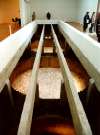 Dimitri
Alithinos dug a pit beneath the Greek Pavilion, filled it with several giant vats of
metallic goop, and titled it "Seventy-Second Concealment." At the end of the
Biennale, the work was "concealed in public," where it "will remain in situ
under the Greek Pavilion forever." Dimitri
Alithinos dug a pit beneath the Greek Pavilion, filled it with several giant vats of
metallic goop, and titled it "Seventy-Second Concealment." At the end of the
Biennale, the work was "concealed in public," where it "will remain in situ
under the Greek Pavilion forever."
Montenegro
Vojo Stanic's surrealist paintings were a delight (and probably my favorite works at the
Biennale).
Romania
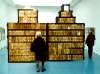
Ion Bitzan's The Library (below) was one of several intriguing sculptures
by this artist from Bucharest, who died on Sept. 16, 1997, during the Biennale. Another
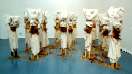
Bitzan sculpture, Sanzienele (St. Diane), added a touch of topless whimsy to the
Romanian Pavilion.
Republic of Korea
Ik-Joong Kang lined a room with small wooden tiles, each labeled with pictures or
phrases such as "Time to make donuts," "I shit often, or "Today I
repent." Loudspeakers were hidden at various locations behind the tiles, and excerpts
from a recorded Italian language course were uttered at random from different points in
the room.
Spain
Joan Brassa had a collection of what might be called objects in juxtaposition: a glass
with a nail through it, a handcuff attached to a rhinestone bracelet, a shoe laced with a
ball of string, and a soccer ball with a flamenco dancer's comb atop it and labeled "Pais"
("Country"). Less amusing works included an iron garotte at a dinner table (the
garotte, now retired, was used for Spain's last execution in 1974) and a piece called
"Interval" that consisted of three chairs facing a music stand with submachine
guns for instruments.
Related article and Web site
La Biennale di Venezia
An overview of Venice's biennial celebration of modern art, with instructions on
how to reach the festival grounds by public transportation.
| 
 Helping
30+ million
Venice travelers since 1997
Helping
30+ million
Venice travelers since 1997