|
Europe
> Spain >
Madrid > Museums
Madrid, Spain
Page 4
Continued from page 3
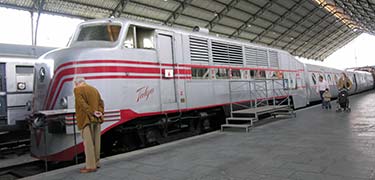
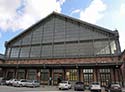
ABOVE: A Talgo articulated train in the Museo
del Ferrocarril.
Museums in Madrid
 Madrid
isn't just a tourist city; it's a national capital and the center of a
metropolitan area with 6.5 million residents. Because of this, Madrid is blessed
with museums of every stripe--from internationally celebrated art galleries to
specialized museums such as the Real Madrid F.C. Trophy Exhibition,
which is included in the football club's self-guided
Bernabéu Stadium
tour. Madrid
isn't just a tourist city; it's a national capital and the center of a
metropolitan area with 6.5 million residents. Because of this, Madrid is blessed
with museums of every stripe--from internationally celebrated art galleries to
specialized museums such as the Real Madrid F.C. Trophy Exhibition,
which is included in the football club's self-guided
Bernabéu Stadium
tour.
 The
best-known museums are on the city's "Paseo del Arte": The
Museo Nacional del Prado, with
its world-renowned collection of paintings by great Spanish artists and other
European Old Masters; the
Museo Nacional de
Arte Reina Sofia (inset photo), which focuses on art from the late 19th
Century to the present day; and the
Museo
Thyssen-Bornemisza, a vast privately-owned collection with works by Titian,
Goya, Degas, Renoir, Kandinsky, and other artists from the 13th through the 20th
Centuries. The
best-known museums are on the city's "Paseo del Arte": The
Museo Nacional del Prado, with
its world-renowned collection of paintings by great Spanish artists and other
European Old Masters; the
Museo Nacional de
Arte Reina Sofia (inset photo), which focuses on art from the late 19th
Century to the present day; and the
Museo
Thyssen-Bornemisza, a vast privately-owned collection with works by Titian,
Goya, Degas, Renoir, Kandinsky, and other artists from the 13th through the 20th
Centuries.
 The
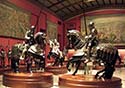
Palacio Real, a.k.a. the Royal
Palace, is another of Madrid's classic museums. (It's no longer a home; King
Juan Carlos prefers humbler lodgings.) You can
visit the official rooms, the pharmacy, and the Royal Armory. The
Palacio Real, a.k.a. the Royal
Palace, is another of Madrid's classic museums. (It's no longer a home; King
Juan Carlos prefers humbler lodgings.) You can
visit the official rooms, the pharmacy, and the Royal Armory.
Other noteworthy museums include
the
Museo Nacional de Artes
Decorativas (featuring some 60,000 objects for visitors who prefer material
culture to "flat art"), the
Museo Cerralbo (an
historic mansion filled with priceless objects), the
Museo Serrolla (an early 20th Century
middle-class home with Joaquín Sorolla y Bastida's paintings and personal
collections), the Museo del Traje
costume museum, the Museo Naval, and
the Museo Arqueológico Nacional.
 Several
municipal museums charge no entrance fees: among them, the
Museo Municipal de
Arte Contemporáneo, the
Museo de San Isidro (Madrid archaelogy and early history), and the
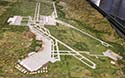
Museo Ciudad
(see inset photo) which has interesting city models but is geared mostly to
school groups. Other free city museums are the
Templo de Debod, an ancient
Egyptian temple in a park next to the Plaza de España, and the
Museo al Aire Libre de La Castellana with its collection of abstract Spanish
sculptures. Several
municipal museums charge no entrance fees: among them, the
Museo Municipal de
Arte Contemporáneo, the
Museo de San Isidro (Madrid archaelogy and early history), and the
Museo Ciudad
(see inset photo) which has interesting city models but is geared mostly to
school groups. Other free city museums are the
Templo de Debod, an ancient
Egyptian temple in a park next to the Plaza de España, and the
Museo al Aire Libre de La Castellana with its collection of abstract Spanish
sculptures.
 If
you're a railfan or are traveling with children, the
Museo del Ferrocarril or Train
Museum is worth visiting (although it has a few too many "No tocar" signs for my
taste). It occupies an old railroad station, and you can take the kids for a
ride on a small model steam train. If
you're a railfan or are traveling with children, the
Museo del Ferrocarril or Train
Museum is worth visiting (although it has a few too many "No tocar" signs for my
taste). It occupies an old railroad station, and you can take the kids for a
ride on a small model steam train.
Another popular transportation museum is
Andén Cero/Estación
Chamberí, (in English, Platform Zero/Chamberí Station). Admission is free to
the vintage Madrid Metro station, which was abandoned in 1966 and restored 40
years later.
At Ventas, in the city's Plaza de
Toros, the
Museo Taurino or Bullfighting Museum has relics from the 18th to 20th
centuries (such as matador costumes, bullfighting gear, stuffed toro
heads, and the bloodied outfit worn by Manolete when he was killed by a bull in
1947).
Next page:
Day trips
|