Paris Métro - How to Ride the
Trains
From:
Paris Métro
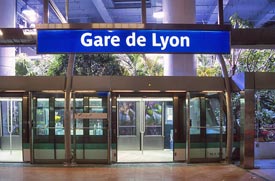
ABOVE: A station of the automated
Meteor Line, with glass
screens between the platforms and the driverless trains.
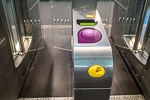
INSET BELOW: Turnstiles vary in appearance, but
most have a slot on the front for T+ cardboard tickets and a purple area on top
for swiping plastic cards such as Navigo Easy. (In some stations, you may see a
few turnstiles without T+ ticket slots.)
After you've bought your ticket, carnet, or pass, you're ready
to enter the Métro via the turnstiles. Here's what
to do:
-
 Step up to the turnstile and insert your cardboard
T+ ticket into
the slot with the magnetic side down. Step up to the turnstile and insert your cardboard
T+ ticket into
the slot with the magnetic side down.
-
Continue through the turnstile, taking your ticket as it emerges from the slot on top of the machine.
Keep the ticket with you. You'll need it if an inspector asks to see your
ticket, and you may also need it to change Métro
lines, to transfer from the Métro to the RER, or (less commonly) to exit via the turnstiles at
your destination.
-
If you're using a plastic card such as Navigo Easy, swipe it
against the purple card reader to open the turnstile gate.
-
Once you're past the turnstiles,
follow the signs to the platform for the direction in which you want to travel.
Stations have large wall maps of the Métro network, and free maps are available
from ticket windows in Métro stations.
-
On the platform, you'll see
monitors that tell when the next train will arrive. Normally you won't have to
wait more than a few minutes.
-
If the doors of the arriving train don't open, flip the metal door lever
(on older trains) or press the door button (on newer trains). Let passengers
get off before you board the train.
-
When a train is crowded, it's good
form to avoid using the jumpseats near the doors and the seats that are reserved
for disabled war veterans, the handicapped, and the elderly. (Parisians don't
always follow the rules, but you aren't a local yokel.)
-
After reaching your destination,
follow the Sortie sign to the exit. At some stations, you'll need your
ticket or pass to exit through the turnstiles.
More tips:
-
Tickets sometimes don't work in the turnstiles. If your ticket doesn't
work, try another turnstile--and if you're still out of luck, go to the information window in the station.
-
Keep old tickets separate from
new tickets and the ticket that you're currently using, or you'll find
yourself playing ticket roulette at the entrance and exit turnstiles.
-
When transferring between Métro
lines, or between the Métro and the RER, you'll sometimes need to exit
through one set of turnstiles and re-enter through another with your
existing ticket.
-
If you're transferring to the
RER for a trip to the suburbs (e.g., to Versailles on RER Line C or to
Charles de Gaulle Airport on RER Line B), you'll need to pay more than the
basic Métro fare. Look for menu options on the ticket machines, which have
choices and instructions in several languages (including English).
Next page:
Métro Web links
Top photo: Copyright © Paris Tourist Office.
Photographer: Catherine Balet.
Inset photo: Copyright © Jan Kronendonk.
| |
|

 Has
Paris reopened for travel?
Has
Paris reopened for travel?