| Germany Index | Europe for Visitors |
 "Best
of the Web" - Washington Post
Save
on car rental with short-term leasing
"Best
of the Web" - Washington Post
Save
on car rental with short-term leasing
"Best
of the Web" - Washington Post
Save
on car rental with short-term leasing
|
|
Erfurt History and BackgroundFrom: Erfurt, Germany
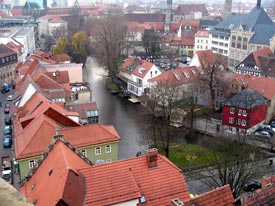
ABOVE: This picture of Erfurt's historic center was taken from the tower of the St. Aegidius Church, which you can climb for a small fee. According to Erfurt Past and Present, the Gera River Valley has been inhabited for at least 100,000 years. (The city took its name from "Erpha," which meant "brown water" and was the river's name until relatively modern times.) The earliest written records of Erfurt are from 742 A.D., when a diocese was established in the town of "Erphesfurt." The town grew into an important trading and warehousing center over the next few centuries. During the Middle Ages, Erfurt prospered from the woad trade, selling the plant-based blue dye (known as "the golden fleece of Thuringia") throughout Europe until indigo arrived from the tropics in the 16th Century. Religion and education also played an important role in the city's history during the second millennium. In its heyday as a religious center, Erfurt had some 90 churches, chapels, monasteries, and convents, and its university--the fourth in Germany--was founded in 1392. Erfurt also played an important part in the Reformation: Martin Luther became a monk and entered the priesthood in Erfurt, and the majority of the population converted to Protestantism after Luther proclaimed his theses in Wittenberg in 1517. In the centuries after the Thirty Years' War, Erfurt was occupied by the Swedes, turned over to the Prussians, seized by Napoleon, handed back to the Prussians, and later incorporated into the German Democratic Republic (DDR). Erfurt became the capital of Thuringia in 1991, two years after the reunification of Germany. Today, the city has a population of more than 200,000, although it feels much smaller within the boundaries of the historic Innenstadt. Thanks in part to its restored medieval center and a strong preservation ethic, Erfurt has been accepted into Historic Highlights of Germany, a tourist consortium of 14 German cities that offer "special charm, architectural brilliance, and historic character." Next page: Martin Luther in Erfurt
|
|
|
| Germany for Visitors - Home | | Europe for Visitors - Home | | About us | | Press clippings | | Testimonials | Disclosure: Where hotel or other reservation links point to third-party booking sites, we may receive a small commission on transactions. This will not affect the rate you pay. Copyright © 1996-2026 Durant and Cheryl Imboden. All rights reserved. |