| Munich Index | Germany Index |
 Save
on car rental with short-term leasing
Save
on car rental with short-term leasing
Save
on car rental with short-term leasing
|
|
Dachau Concentration Camp Memorial SiteKZ-GedenkstätteFrom: Munich, Germany 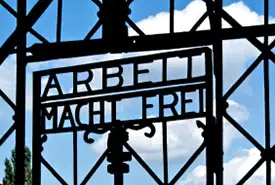 ABOVE: The infamous "Work sets you free" slogan on the wrought-iron gates at the Dachau camp entrance.
Today, the Dachau Concentration Camp Memorial Site (which opened in 1965) is visited by at least 800,000 people each year--mostly Germans, and especially German students, who typically visit at least one former concentration camp during the upper grades of high school. About the camp:
The Dachau KZ, or Konzentrationslager, was a model for later camps, including more than 150 subsidiary camps in the region. It began as a prison for German political enemies of the Reich, but over time it became a processing center and forced-labor camp for Jews, Sinti, Roma, homosexuals, Jehovah's Witnesses, prisoners of war from Eastern Europe, and other groups. After 1942, Dachau was also used for SS medical experiments. (It was never a mass-extermination camp, although an estimated 43,000 prisoners died from starvation, illness, or execution before the U.S. Army liberated the camp in 1945.) The Dachau Concentration Camp Memorial Site is well worth visiting, although it can inspire discomfort: not merely for Germans ("What did your Grossvater do in the war?"), but also for foreign tourists who may find themselves thinking of Abu Ghraib, Guantanamo, and "enhanced interrogation techniques" such as waterboarding as they tour the camp and its torture cells. Visitor information:The Concentration Camp Memorial Site is in the Munich suburb of Dachau, about 20 minutes from the Hauptbahnhof (Munich's main railroad station) by S-Bahn train. At the Dachau railroad station, you can transfer to a bus for the five-minute ride to the camp. See "Getting to the camp" below for illustrated step-by-step directions via public transportation. Visiting hours are 9 a.m. to 5 p.m. Tuesday through Sunday and on all public holidays. Admission is free. The camp offers audioguides and 30-minute or 2½-hour walking tours, or you can book an escorted coach tour from Munich. You can just as easily explore the camp on your own, preferably after spending an hour or two in the Exhibition or museum, which tells the camp's grim history through displays, a movie, and other exhibits. For more visitor information, see the Dachau Web links at the end of this article. Getting to the campThe directions below are for public transportation via Munich's clean, quick, and convenient S-Bahn. If you'd rather fight city and suburban traffic in an automobile, see the Dachau Concentration Memorial Site's directions page and scroll down to "Arriving by car." (There's a parking fee from March to October, and you must pay in cash.) S-Bahn directions:
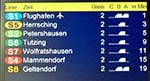
1. From Munich's city center, you'll be taking the S-Bahn S2 line in the direction of Petershausen. Start by purchasing a ticket to Dachau from one of the vending machines, and stamp your ticket in one of the blue machines near the S-Bahn entrance. (This is very important--you can be fined if you enter the platforms or board a train without a ticket.) You can also get to the camp with a 1- or 3-day City Tour Card for the Gesamtnetz (Munich regional network) as opposed to the Inneraum (city only). See the MVV (Munich public transportation) Web site for more information.
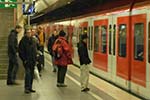
2. Take the escalator or stairway to the train platform. An electronic sign will show the number of minutes until the next S2 Peterhausen train and where to stand on the platform.
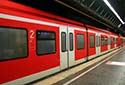
3. Board the S2 Peterhausen train for a ride of approximately 25 minutes to Dachau. (If necessary, push a button to open the doors as you board or exit the train.)
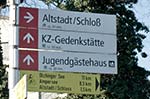
4. At Dachau, leave the railroad station by the main entrance, and ignore the "KZ-Gedenkstätte" pedestrian sign unless you're prepared for a 50-minute walk.
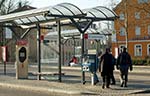
5. Cross the street to the bus stop.
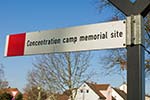
6. Wait for a bus near the sign that reads, "Concentration Camp Memorial Site."
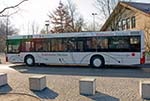
7. Take bus 726 to the camp. (Board at the front and show your S-Bahn ticket to the driver.)
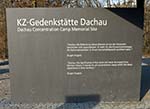
8. Exit the bus at the KZ-Gedenkstätte, which is the end of the line. Entering the camp
As you leave the bus stop, you'll pass a small building where you can buy books, rent an audioguide, sign up for a guided tour, or use the WCs. (More toilets are in the Exhibition building within the camp.)
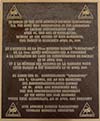
Near the KZ entrance, you'll see a bronze plaque that commemorates the liberation of the camp by the U.S. Army's 20th Armored Division on April 29, 1945. 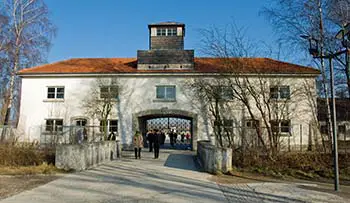
The only entrance to the concentration camp is through the Jourhaus, or guardhouse, where you'll see the motto "Arbeit macht frei" on the wrought-iron gate beneath the archway, as shown in the photo at the beginning of this article. |
| One egg | Glass of beer | |
| 1914 | 0,08 Mark | 0,13 Mark |
| 1918 | 0,25 Mark | 0,17 Mark |
| 1922 | 180 Marks | 60 Marks |
| 1923 | 80 Billion Marks | 150 Billion Marks |
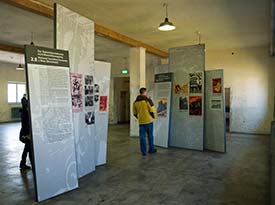
The Exhibition has an auditorium where you can watch a documentary film, KZ Dachau, that includes newsreel footage of the camp's liberation. The 22-minute movie isn't for the squeamish or for young children, but it's well worth watching.
Official show times are Tuesday through Sunday at 11 a.m. and 3 p.m. (German) and 11:30 a.m. and 3:30 p.m. (English), with additional showings in French, Italian, German, or English upon request.
WCs are in the Exhibition building, next to the movie theatre and near the office/library wing. The building also has two wheelchair-accessible toilets, one near section 4 and the other by the library and offices.
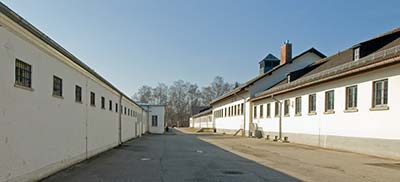
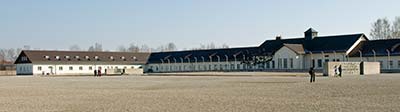
The bunker, or camp prison, is on the left in this photo.
The maintenance building (now the Exhibition or museum) is on the right, and the courtyard between the two buildings was used for whippings, pole hangings, and executions during the Nazi era.
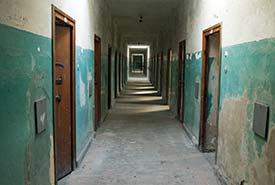
You can walk through the interior of the bunker, where labels identify areas of special interest.
In addition to serving as a prison, the bunker was the camp's torture center. Double walls were used to suppress the sound of prisoners' screams.
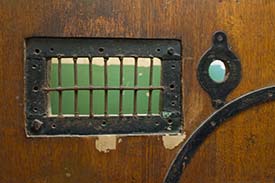
The U.S. Army used the bunker as a prison after World War II. The grille in this cell door was an American addition.
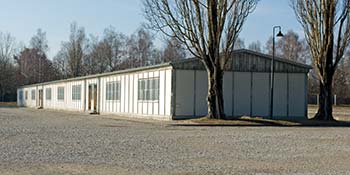
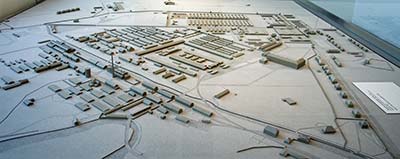
Most prisoners lived in the camp's accommodations barracks or bunkhouses, which were arranged in two rows alongside the camp road.
(The road, which was planted with populars, was the main recreation area for prisoners during their limited free time.)
The old, crumbling barracks were torn down in 1964, after serving as postwar refugee housing. One building has been reconstructed with interior furnishings from three periods: 1933-1938, 1938-1944, and 1944-1945.
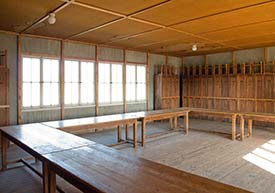
This 1938 common room shows the tables where the prisoners ate their skimpy meals. You can also see wooden lockers along the back wall.
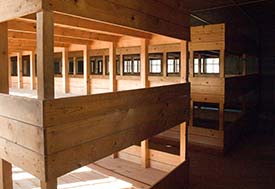
AAs the camp became more crowded, rows of individual bunk beds were replaced by group bunks. This reconstruction shows what the prisoners' sleeping quarters looked like in 1944.
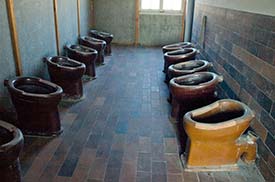
Sanitation may have been adequate in 1933, when the barracks were built to accommodate 200 prisoners each, but by the end of the war, each building held up to 2,000 inmates.
Many prisoners died of diseases, especially during a 1943 typus epidemic that killed at least 1,000.
Overcrowding persisted for several years after World War II, when Dachau was a U.S. Army prison camp for German POWs.
Later, the barracks were converted into refugee quarters, where several thousand ethnic Germans from the Sudetenland lived until work began on the KZ-Gedenkstätte or memorial site in 1964./p>
Odd sighting: During my visit, I noticed coins in the fountain-like sink at right. (Is it human nature to throw coins into anything that looks like a fountain, even if it's an industrial sink without water in a former concentration camp?)

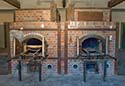
The Dachau concentration camp has two crematoria: a small building from 1940, which the SS, and a second, larger crematorium (Barrack X, shown above) that was built in 1942-1943.
Both crematory buildings are outside of the camp's perimeter fence. You can reach them through a gate on the left side of the camp near the Protestant Church of Reconciliation.
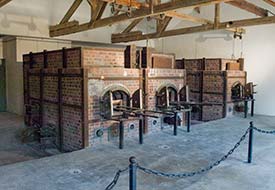
The crematorium ovens were coal-fired. Although Baracke X had a Zyklon gas chamber, it was never used for mass extermination. Instead, condemned prisoners were executed (usually by hanging) in front of the ovens.
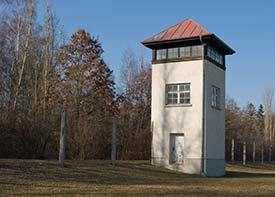
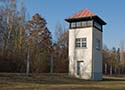
ABOVE: A guard tower on the camp perimeter.
Dachau Concentration Camp Memorial Site
The English-language version of the
KZ-Gedenkstätte
Web site has visitor information, historical backgrounds, a virtual tour, and
more.
City of Dachau: Tourism
There's more to Dachau than the concentration camp, and the city's
English-language tourism pages have listings of hotels, restaurants, events,
etc. If you'd rather stay in Dachau than in Munich, the
Hotel Fischer is a convenient choice: It's directly across the
street from the Dachau train station and bus stop.
Dachau
Concentration Camp
This extensive site is probably the Web's most complete guide to the KZ
and its history. It includes many photos, excerpts from original sources, and an
especially interesting section on what happened during and immediately after the
liberation of Dachau
in 1945.
Dachau
Concentration Camp (Wikipedia)
This article gives an historical overview, has a list of famous prisoners,
and includes academic citations.
About the author:
 Durant Imboden
is a professional travel writer, book author, and editor who focuses on European
cities and transportation.
Durant Imboden
is a professional travel writer, book author, and editor who focuses on European
cities and transportation.
After 4-1/2 years of covering European travel topics for About.com, Durant and Cheryl Imboden co-founded Europe for Visitors (now including Germany for Visitors) in 2001. The site has earned "Best of the Web" honors from Forbes and The Washington Post.
For more information, see About Europe for Visitors, press clippings, and reader testimonials.
Top photo iStockphoto.com/Steven Phraner.
S-Bahn
photo iStockphoto.com/Tan Wei Ming.
|
| Germany for Visitors - Home | | Europe for Visitors - Home | | Contact information, disclosures, audience | Disclosure: Where hotel or other reservation links point to third-party booking sites, we may receive a small commission on transactions. This will not affect the rate you pay. Copyright © 1996-2026 Durant and Cheryl Imboden. All rights reserved. |
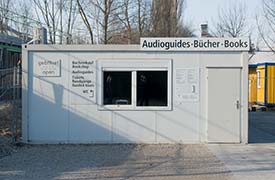
 In the not-too-distant
future--perhaps by the time you read this article--this prefab building will
have been replaced by a modern visitor center
and café.
In the not-too-distant
future--perhaps by the time you read this article--this prefab building will
have been replaced by a modern visitor center
and café.