|
| Venice Home | All topics |
| Where to stay | Transportation |
 Helping
30+ million
Venice travelers since 1997
Helping
30+ million
Venice travelers since 1997
Helping
30+ million
Venice travelers since 1997
|
|
Campanile di San Marco
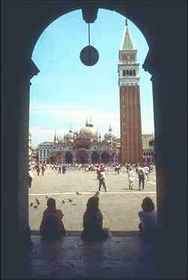
ABOVE: The Campanile di San Marco rises above St. Mark's Square. From its viewing gallery, you can look out over Venice's historic center and the Venetian Lagoon.
The Campanile di San Marco, or Belltower of St. Mark's, has stood for more than a thousand years--or for less than a century, depending on how you define truth in advertising. The present-day structure was built in 1912 as an exact replica of its predecessor, which collapsed unexpectedly on the morning of July 14, 1902. Ian Littlewood's Venice: A Literary Companion quotes an American architect's eyewitness report of the slow-motion implosion in The Times of London:
Some Venetians claimed that St. Mark's Square looked better without the tower, and others thought it was foolish to spend taxpayers' money on a replacement. In the end, donations from outside Venice covered most of the expense, and a rebuilt Campanile was christened on April 25, 1912--exactly 1,000 years after the foundations of the original structure had been laid, according to historians of the time. A solar-powered lighthouseAlthough "campanile" means "bell tower," the Campanile di San Marco did double duty as a military watchtower when it was constructed in the 10th Century. Later, as the tower was expanded and refined, its bronze-sheathed roof caught the sun's rays and acted as a daytime beacon for mariners. The Campanile received an overhaul in the early 1500s after being damaged by an earthquake, giving it the profile that we see today. It also received its share of historic visitors, including Galileo (who showed the Doge his famous telescope in 1609), Goethe (who viewed the Adriatic from the arched windows), and Emperor Frederick III of the Holy Roman Empire, who is said to have ridden his horse up the tower in 1452. A bell for every occasion
The Campanile's five bells were intended to communicate five different messages. The largest signaled the beginning and end of each work day; another rang the hour; a third called senators to the Doge's Palace; the fourth summoned magistrates; and the smallest--il Maleficio--was rung to announce executions of the prisoners who dangled in cages halfway up the tower's walls. The bells are still rung today, but only to maintain tradition and entertain the tourists. A symbol for separatistsOn May 9, 1997, a band of young Venetian separatists hijacked a ferry, drove their homemade armored car and camper van aboard, and steamed up the Grand Canal toward the Piazza San Marco. Upon landing shortly after midnight, the eight would-be revolutionaries smashed through the Campanile's entrance door and made their way to the top. The group then hung a banner with the Lion of St. Mark from the tower windows and announced that "a regular unit of the Most Serene Venetian Army has tonight liberated St. Mark's Square." According to news reports, the escapade was scheduled as a prelude to the 200th anniversary of Napoleon's conquest of Venice, which signaled the end of the thousand-year-old Venetian Republic. Carabinieri (paramilitary police) used a telescopic ladder to reach a balcony on the tower, then climbed to the top and arrested the invaders. No one was hurt, and the Northern League--Italy's main separatist party--later characterized the protesters' actions as "madness." 
Venice for first-time visitors: On a clear day, you can see forever
Providing you aren't dressed up in combat fatigues and carrying weapons, you can see the Campanile's bells at close range for the price of a ticket. (Enter on the Piazzetta side, around the corner from the exit on the Piazza San Marco.) The tower normally opens daily at 9:30 a.m., with closing times that vary according to the season. If you aren't athletic, don't worry--an elevator will whisk you to the viewing platform, providing your feet can stand waiting in line on busy summer days and holiday weekends.
|
|
|
| Venice for Visitors - Home | | Europe for Visitors - Home | | About our site | | Press clippings | | Testimonials |
Disclosure: Where hotel or other reservation links point to third-party booking sites, we may receive a small commission on transactions. This will not affect the rate you pay. Copyright © 1996-2026 Durant and Cheryl Imboden. All rights reserved. |