|
| Venice Home | All topics |
| Where to stay | Transportation |
 Helping
30+ million
Venice travelers since 1997
Helping
30+ million
Venice travelers since 1997
Helping
30+ million
Venice travelers since 1997
|
|
Cats of Venice
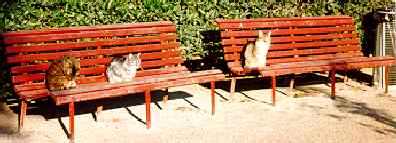
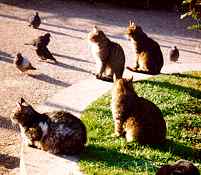
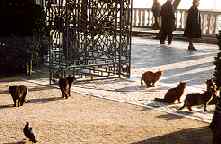
PHOTOS: Cats sun themselves in Venice's former royal gardens, a few steps from St. Mark's Square.
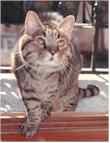
The Lion of St. Mark is Venice's mascot, at least among sculptors and decorators. In real life, the closest lion is probably at the Parco Natura Viva just outside Verona, 74 miles (118 km) away. With no living lions to reign over Venice, the local feline population has adopted a surrogate leonine role. Back in the 1990s, when we took the photos in this article, cats were seen everywhere in the city: sunning themselves on park benches, perched on bridges, wandering the streets, and dining on leftovers at the Rialto fish market. In a delightful book titled A Venetian Bestiary, Jan Morris wrote:
Morris's text, like the photos in this article, are a bit out of date: In recent years, stray cats have nearly disappeared from most Venice neighborhoods, although pet cats seem to be making a resurgence. Most feral cats have been removed to an island sanctuary, which is good news for Venice's rodent population but is a source of annoyance to rat-haters and Venetian traditionalists who lament the days when cats were seen more often than dogs. Are Venice's few remaining stray cats dangerous? Some worry-warts might think so, for it's doubtful that any feral cats wandering the streets of Venice have had rabies shots. Still, if you leave them alone, they'll probably leave you alone--unless, of course, you're a fish or a rat, in which case all bets are off.
|
|
|
| Venice for Visitors - Home | | Europe for Visitors - Home | | About our site | | Press clippings | | Testimonials |
Disclosure: Where hotel or other reservation links point to third-party booking sites, we may receive a small commission on transactions. This will not affect the rate you pay. Copyright © 1996-2026 Durant and Cheryl Imboden. All rights reserved. |