|
| Venice Home | All topics |
| Where to stay | Transportation |
 Helping
30+ million
Venice travelers since 1997
Helping
30+ million
Venice travelers since 1997

Helping
30+ million
Venice travelers since 1997
|
|
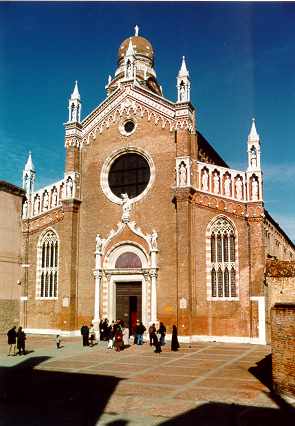
Madonna dell'Orto
ABOVE: Madonna dell'Orto has been described as "the finest Gothic church in Venice."
Madonna dell'Orto is a church and a parish that most Venice tourists never see. In Venice: A Literary Companion, Ian Littlewood explains what they're missing:
The paintings are by Tintoretto, who lived and worked just a few blocks away on the Fondamenta dei Mori. Hugh Honour, art historian and author of The Companion Guide to Venice, describes Tintoretto's connection to the church:
John Ruskin, the 19th Century art critic and social commentator, painted this evocative verbal portrait of The Last Judgment:
Other notable features of the church (besides a plethora of fine paintings) include Tintoretto's tomb (see above) and a statue of a "Madonna of the Garden" (Madonno dell'Orto) in the chapel of San Mauro, which was discovered in a neighboring garden in the late 1300s and was said to possess miraculous powers. The statue served as an excuse to renovate the church, which originally was dedicated to St. Christopher and has been used as a gunpowder magazine, a barn for storing straw, and a stable at various times in its nearly 650 years of existence. Transportation, hours, and surroundings See the next two pages for information on how to reach Madonna dell'Orto, when the church is open, and things to see in the vicinity (with photos). Next page: Visitor information
|
|
|
| Venice for Visitors - Home | | Europe for Visitors - Home | | About our site | | Press clippings | | Testimonials |
Disclosure: Where hotel or other reservation links point to third-party booking sites, we may receive a small commission on transactions. This will not affect the rate you pay. Copyright © 1996-2026 Durant and Cheryl Imboden. All rights reserved. |