| Germany Index | Europe for Visitors |
 "Best
of the Web" - Washington Post
"Best
of the Web" - Washington Post
"Best
of the Web" - Washington Post
|
|
Freiburg History and BackgroundFrom: Freiburg im Breisgau, Germany
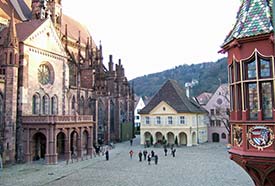
ABOVE: The Münster (cathedral), the Alte Wache (where you can sample regional wines), and the Historisches Kaufhaus. INSET BELOW: The Freiburg Official Guide. History
Another landmark, the Kaufhaus or Merchant's Hall, was first mentioned in 1378. A year later, Freiburg obtained royal permission to have two yearly fairs, both of which continue to this day. Freiburg's Albert-Ludwigs-Universität (a.k.a. the Uni Freiburg) was founded in 1457, making it one of the oldest universities in what was then Austria. In 1507, a cartographer from Freiburg--Martin Waldseemüller--published a book of maps with a continent called "America" (the first recorded usage of that name).
Over the next several centuries, Freiburg had two plague epidemics, was decimated by the Thirty Years' War, and was variously occupied by the French, Austrians, and other invaders. At one point, its population was down to 3,000 people, mostly women.
Freiburg im Breisgau todayExcept for the Münster, which was untouched by Allied bombing, nearly all of Freiburg's inner city was rubble at the end of World War II.
Today's city is focused on the pedestrian zone, with trams providing access to the main shopping streets (all of which are within shouting distance of the cathedral) and parking being restricted to the periphery.
Next page: Sightseeing and local tours
|
|
|
| Germany for Visitors - Home | | Europe for Visitors - Home | | About us | | Press clippings | | Testimonials | Copyright © 1996-2024 Durant and Cheryl Imboden. All rights reserved. |

 Freiburg
had a resurgence in the early 1800s, and in the years before World War I, it was
a lively town with electric trams, a new theatre, and new university buildings.
The city was damaged in two world wars--first by the German Air Force, which
accidentally killed 57 people, and later by the Allies, who killed some 3,000
people and destroyed much of the city on November 27, 1944. After World War II,
Freiburg was in the French occupation zone, and it became part of the new German
Land or state of Baden-Württemberg in 1954.
Freiburg
had a resurgence in the early 1800s, and in the years before World War I, it was
a lively town with electric trams, a new theatre, and new university buildings.
The city was damaged in two world wars--first by the German Air Force, which
accidentally killed 57 people, and later by the Allies, who killed some 3,000
people and destroyed much of the city on November 27, 1944. After World War II,
Freiburg was in the French occupation zone, and it became part of the new German
Land or state of Baden-Württemberg in 1954.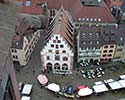 Freiburg
officials decided to rebuild on the old medieval street plan, reconstructing a
handful of landmark buildings (such as the Historisches Kaufhaus and the
Kornmarkt) while requiring new structures to fit what the authors of
Livable
Cities Observed describe as "modern buildings in the spirit of the
medieval city." (The authors note: "Some buildings constructed in 1952 preserved
the city's historic character so well that they are already placed under
preservation law.")
Freiburg
officials decided to rebuild on the old medieval street plan, reconstructing a
handful of landmark buildings (such as the Historisches Kaufhaus and the
Kornmarkt) while requiring new structures to fit what the authors of
Livable
Cities Observed describe as "modern buildings in the spirit of the
medieval city." (The authors note: "Some buildings constructed in 1952 preserved
the city's historic character so well that they are already placed under
preservation law.") The
net result is a human-scale urban center with shops, restaurants, small hotels,
beer gardens, public markets, street entertainers, museums, and even the Black
Forest (which begins at the city's doostep with the Schlossberg, the forested
hillside park just east of the pedestrian zone). The authors of Livable
Cities Observed describe Freiburg as "a city of vision," and it's a vision
that's well worth seeing.
The
net result is a human-scale urban center with shops, restaurants, small hotels,
beer gardens, public markets, street entertainers, museums, and even the Black
Forest (which begins at the city's doostep with the Schlossberg, the forested
hillside park just east of the pedestrian zone). The authors of Livable
Cities Observed describe Freiburg as "a city of vision," and it's a vision
that's well worth seeing.