|
Europe
> Switzerland > Thun
Thun and its castle
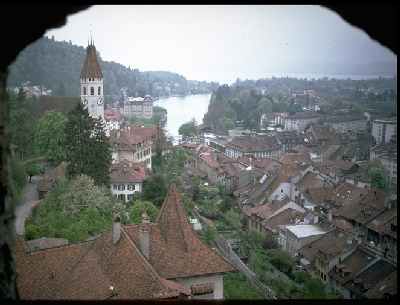
ABOVE: A view toward the lake from Schoss Thun.
By
Durant
Imboden
Thun
(pronounced "Toon") is a city of nearly 40,000 that has occupied an
important role in cantonal affairs since the Gentlemen of Bern acquired it from the House
of Kyburg in 1384.
The town is located at the northwestern corner of Lake Thun (Thunersee), where
the River Aare flows out of the lake on its 24-mile journey toward the Swiss capital of
Bern. It offers frequent train and boat service to nearby Interlaken, the hub of the
Jungfrau region, yet it's only a 20-minute commute from Bern.
Trains also head south over
the Loetschberg Pass to Brig, which offers easy railway connections to Italy and the
popular Glacier Express between Zermatt and St. Moritz. In short, Thun is both a
transportation hub and a convenient base for city and mountain excursions.
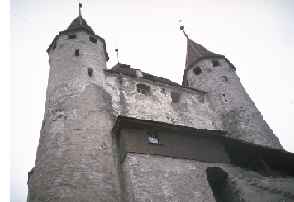
But
that's not all. Thun is a tourist destination in its own right, with a magnificent
turreted castle (now a museum) that has dominated the Thin skyline since Duke Berthold V
of Z�hringen ordered it built in 1191.
Paul Guiton, author of an undated travel guide
titled Switzerland: Northern and Eastern from 70 or 80 years ago, had this
description of Thun and its castle:
Thun is approached by one of the arms of the Aare, in which rushes and
other aquatic plants flourish and sway gently in the current. Nothing can be more
delightful than the little town, the principal street of which has on either of its sides
two footways raised above each other, so that there are four rows of neat little shops,
some of them old, others modern.
Above the town, and reached by flights of steps which are
covered, are a church, a cemetery, a rose-garden, and a château, fitting abode for any
fair princess seeking a retreat remote from the busy haunts of men....
In front of the château the limpid trickle of a fountain drips steadily
into a round basin. We get a glimpse of a bit of wall with chestnut trees shedding their
blossom; the bold square tower with its four round turrets, capped by conical roofs,
stands out with a certain dignity, but not so proudly as the Stockhorn which man aped when
he built these towers.
Watchtowers at the four corners of the cemetery afford wonderful
views of the lake and the snow crowned peaks in the distance--the Blümlisalp, the
Jungfrau, the M�nch, the Eiger, and the Schreckhorn. Who can doubt but that the souls of
those buried here are ever looking down from those crests upon the quiet places they once
loved so well!
Although Thun is no longer the "little town" of Guiton's day, its
urban center hasn't changed dramatically over the last half-century. The Rathausplatz
still has a massive 16th Century city hall, and the businesses on the
Hauptgasse continue to be arranged on two levels, with the sidewalks outside the
upper-story shops serving as an arcade for the stores at ground level.
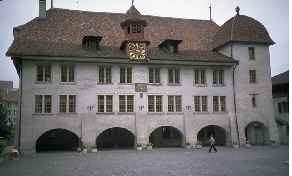
ABOVE: Thun's Rathaus, or City Hall.
Sights and excursions
During your visit to Thun, be sure to see:
Schloss Thun. Thun Castle (described
above) is open year-round. As you explore the interior, you can enjoy views of
the town, Lake Thun, and distant Alps from the castle windows.
Kunstmuseum Thun, housed in a former grand hotel on the Aare River, has a
large collection of modern paintings,
sculptures, and photographs.
Thun Panorama (formerly the Wocher-Panorama),
a pavilion in Schadau Park where you can see a panoramic painting of Thun as it looked in
1810.
Schloss Oberhofen, a handsome castle in a beautiful setting
on Lake Thun. The castle is a branch of the Bern Historical Museum, with a collection of
period furniture and displays on local life in earlier times. You can reach the castle by
lake steamer and hike back to Thun along the shore.
Dampfbahn
Vaporama Schadowpark Thun offers excursions on a miniature steam railway.
Trains normally operate two weekends per month from April to October and
on certain holidays (see
timetable). The
ride is inexpensive, and multi-ride punchcards are available.
Where to stay
Booking.com: Thun our partner
The No. 1 hotel site in Europe offers competitive rates with secure booking at
hotels, B&Bs, and other accommodation in Thun and its surroundings. Listings
include photos, ratings, and reviews by paying guests.
Tourist information
For more information about Thun and nearby attractions, please see:
Thunersee
This English-language regional tourism site focuses on both the
city
and Lake Thun.
About the author:
 Durant Imboden
is a professional travel writer, book author, and editor who focuses on European
cities and transportation. Durant Imboden
is a professional travel writer, book author, and editor who focuses on European
cities and transportation.
After 4-1/2 years of covering European travel topics for About.com, Durant and
Cheryl Imboden co-founded Europe for Visitors in
2001. The
site has earned "Best of the Web" honors from Forbes and The
Washington Post.
For more information, see
About
Europe for Visitors,
press clippings, and
reader
testimonials.
| 
 Save
on car rental with short-term leasing
Save
on car rental with short-term leasing