Coffeehouses in Vienna
By
Durant
Imboden
Coffeehouses
are more commonplace than
McDonald's in the English-speaking world these days, but they were a part of
Viennese culture long before Seattle ever heard of Starbucks. What's more, the
Kaffeeh�user
of Vienna have more in common with Parisian literary cafés or English pubs than
they do with modern espresso bars that serve latté in paper cups. The
Austrian writer Stefan Zweig described the Viennese café as "an
institution of a special kind...a sort of democratic club for discussion,
writing, and playing cards."
Don't let Zweig's description keep you from patronizing Vienna's coffeehouses
if you prefer solitary sipping to activities befitting an extrovert. Another
writer, Alfred Polgar, had this to say about Vienna's legendary
Café
Central, a
Baroque coffeehouse in the grand tradition whose whose patrons have included
Goethe, Beethoven, Mahler, and Trotsky:
"Its inhabitants are, for the most part, people who are
misanthropes, and whose aversion to other people is as acute as their need for
people: who want to be alone, but must have company to do so. The habitué of
the Central is a person who derives no sense of belonging from his family,
profession, or party; the Café Central comes to his rescue, inviting him to
join and escape. Its customers know, love, and underestimate one another. Even
those who profess not to know each other regard this non-relationship as a
kind of relationship; mutual dislike serves as a unifying force at the
Central, a sort of camaraderie. Everyone knows about everybody. The Café
Central is a village in the center of the metropolis, steaming with gossip,
curiosity, and slander."
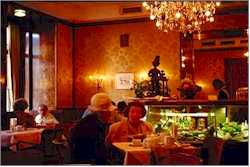
ABOVE: Imperial Café in the Hotel Imperial,
Vienna.
What to order
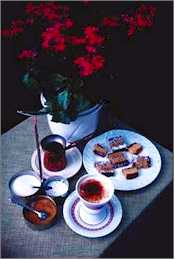
Coffee is the main stock in trade of the coffeehouse, as you might expect,
but the beverage choices are different from what you might expect at home.
Cleanse your mind of familar Italian names like "espresso" and
"cappucino" and memorize these choices instead:
Schwarzer. Strong black coffee. A kleiner Schwarzer is the
equivalent of an espresso; a grosser Schwarzer is a double shot. Also
called a Mokka.
Brauner. Coffee with a dash of milk or cream.
Goldener. Coffee with milk; similar to "regular coffee" in
New York.
Mélange. Equal amounts of milk and coffee with froth.
Kaffee Cr�me. Coffee with a miniature pitcher of milk on the
side.
Kapuziner. Cappucino. (Same name, different language.)
Kurz. A single shot of espresso.
Mokka. See "Schwarzer" above.
Verl�ngter. Coffee with hot water added; a good choice for
visitors who like their coffee weak.
Einsp�nner. Coffee in a glass with a hefty dollop of
Schlagobers or Schlag (whipped cream).
Fiaker. Espresso in a glass with sugar and Kirschwasser
(a dry cherry brandy), topped with whipped cream and a cherry.
Pharis�er. Espresso in a glass with sugar, whipped cream,
cocoa, and a shot of rum.
Many coffeehouses serve other variations on the coffee theme, such as
Eiskaffee
(coffee, vanilla ice cream, and whipped cream) and alcoholic combinations. Also,
you can usually count on a tasty assortment of pastries, especially in the
afternoon.
-
Tip: Viennese coffeehouses fall under two general headings:
traditional coffeehouses (where your coffee may be served on a silver tray with
a glass of water) and modern cafés that cater to a less hidebound crowd. Some
cafés call themselves Konditoreien, or pastry shops, which simply means
that they offer a wide assortment of baked goods.
Web links
Articles/Guides
On
Coffee from Vienna
International NetRestaurant pooh-poohs the legendary tale of how the Viennese
discovered coffee. The page has a link to a Viennese café.
The History of
the Coffeehouse (Kaffeehaus) in Vienna
Read a brief history and a menu of Viennese coffee specialities from
Vienna CC.
About the author:
 Durant Imboden
is a professional travel writer, book author, and editor who focuses on European
cities and transportation. Durant Imboden
is a professional travel writer, book author, and editor who focuses on European
cities and transportation.
After 4-1/2 years of covering European travel topics for About.com, Durant and
Cheryl Imboden co-founded Europe for Visitors in
2001. The
site has earned "Best of the Web" honors from Forbes and The
Washington Post.
For more information, see
About
Europe for Visitors,
press clippings, and
reader
testimonials.
| 
 Save
on car rental with short-term leasing
Save
on car rental with short-term leasing