|
| Venice Home | All topics |
| Where to stay | Transportation |
 Helping
30+ million
Venice travelers since 1997
Helping
30+ million
Venice travelers since 1997

Helping
30+ million
Venice travelers since 1997
|
|
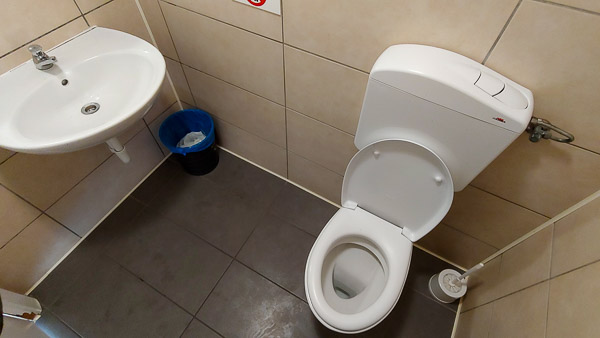
Public Toilets in Venice, ItalyWhen you need to spend a penny in Venice, prepare to pay a lot more: Most public WCs cost €1,50, and your deposits are non-refundable.
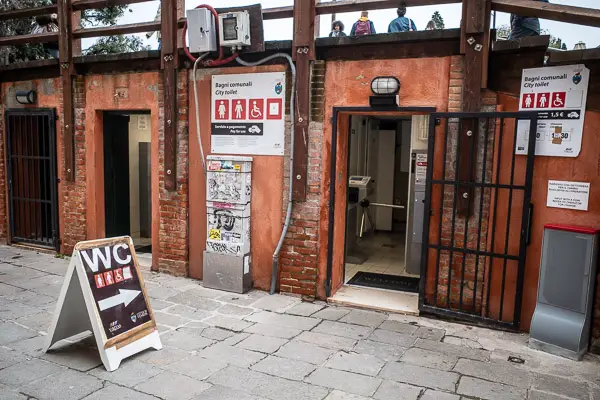
ABOVE: A sign points to the Rialto Novo municipal toilets (see below).
Venice is often criticized for its shortage of toilet facilities. To some extent, the criticism is justified--after all, the city welcomes millions of tourists per year, yet it has only a handful of public WCs scattered around the half-dozen sestieri, or districts, that make up the historic center. It doesn't take a plumber to realize that the existing lavatories are going to be overwhelmed when 50,000 visitors show up with their water bottles on a typical summer day. One could argue--unconvincingly--that building enough restrooms for the masses would require destroying many of the buildings and monuments that tourists come to see. Large-scale deployment of public conveniences might also displace even more Venetians than the 1,200 who already flee to the cheaper, less crowded mainland in a normal year (maybe in search of a place to pee). If it's any consolation, local authorities have promised to build more restrooms as part of an effort to improve tourist infrastructure. A few years ago, the city doubled the prices of using public WCs in what critics have called a "toilet tax" on visitors and residents.
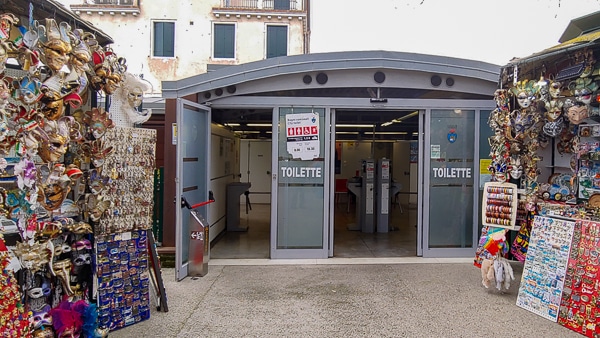
ABOVE: A visitor uses a turnstile at the Diurno public lavatory near the Piazza San Marco. Here's how to make the best of a poor situation:
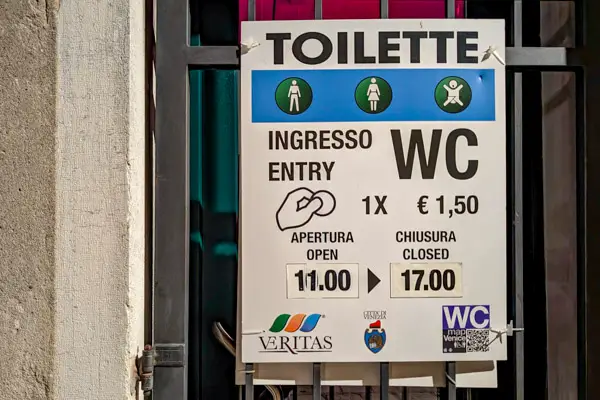 ABOVE: If you rely on Venice's municipal toilets, plan to do your business during business hours. (And don't take the posted hours too literally, since a WC may be closed for any number of reasons.)
Locations of public toilets in the city center:Venice's municipal lavatories are normally open during the day and early evening; hours vary with the location and season. For details about facilities, accessibility, operating hours, etc., click the links in the descriptions below. Our descriptions are keyed to the numbers on this map that we photographed on the wall of a WC:  Click for larger map (1,200 pixels wide) 1. Tronchetto parking garage
There are actually two public WCs on Tronchetto: one inside the garage by the office, and another by a souvenir stand in the parking lot for tour buses. The last time we checked, the Tronchetto WCs were 50 cents cheaper than public toilets in the city. 2. Piazzale Roma
The Piazzale Roma is Venice's gateway for buses, trams, taxis, and cars. You'll find a public WC on the tree-lined side of the square, along a path that leads to a footbridge. The modern building is bracketed by souvenir stands. 3. San Leonardo
The S. Leonardo WC is conveniently located just off the main pedestrian thoroughfare between Venice's Santa Lucia Railroad Station and the Piazza San Marco. It's next to the Frito-Inn, on a tiny square on the right side of the street as you walk east from the Cannaregio Canal. 4. Accademia
It's hard to miss this public toilet: It's beneath the Dorsoduro end of the Accademia Bridge, close to the Accademia vaporetto stop and the Gallerie dell'Accademia art museum. 5. Rialto Novo
Look for a "WC" decal beneath the arches, which points to the toilet's location in the Campo Rialto Novo. 6. San Bartolomeo
The toilet is close to the Campo San Bartolomeo in the San Marco district, near the Rialto Bridge. 7. Diurno San Marco
Signs on nearby buildings and on paving stones west of the piazza, just past the tourist office, make the Diurno San Marco WC easy to find. 8. Giardini Reali San Marco
9. SS. Filippo e Giacomo
10. Bragora
This is another WC that can be tricky to locate, especially if you're approaching it from a rabbit warren of inland streets. Your best bet is to come from the waterfront promenade of Riva degli Schiavoni.
11. Giardini Napoleonici di Castello
You'll find this WC handy during the Biennale art exposition. It's located in the Giardini Publicci (Public Gardens), which are 15 or 20 minutes east of the Piazza San Marco and the Doge's Palace as you walk along the waterfront. WCs on islands of the Lagoon:Lido Santa Maria Elisabetta
The Lido di Venezia, Venice's beach resort, has a modern and well-equipped WC right next to the Lido Santa Maria Elisabetta (Lido S.M.E.) vaporetto and bus station, which is at the foot of the Lido's busiest shopping street. Smaller islandsLook for city toilets on Murano, Burano, and Torcello. They're well marked and easy to find. Other WCs:Venezia Santa Lucia Railroad Station
Venice's main railroad station (the modern building in the photo above) has state-of-the-art lavatories next to Track 1. These were completely renovated in 2024. The fee is €1,20, and the turnstiles accept cash or credit cards. Other places to go
Official city toilets Web site:
ABOVE: In this public WC on the Lido di Venezia, each toilet stall has its own sink.
WCVeneziatoilette.com The site's WC descriptions include scheduled hours of operation (which aren't always observed), the number of stalls and urinals, whether disabled toilets and "nurseries" or diaper-changing facilities are available, etc. 
Venice for first-time visitors:
|
|
|
| Venice for Visitors - Home | | Europe for Visitors - Home | | About our site | | Press clippings | | Testimonials |
Disclosure: Where hotel or other reservation links point to third-party booking sites, we may receive a small commission on transactions. This will not affect the rate you pay. Copyright © 1996-2026 Durant and Cheryl Imboden. All rights reserved. |




 The
"New Rialto" WC is just off an arcaded passage on the
San Polo side of the
The
"New Rialto" WC is just off an arcaded passage on the
San Polo side of the 
 This
WC may not be the prettiest public lavatory in Venice, but it looks better
inside than out.
This
WC may not be the prettiest public lavatory in Venice, but it looks better
inside than out.
 This
former public bathhouse is one of two restrooms by the Piazza San Marco.
(It's also the largest WC in the city.) You
can enter by either of two entrances. Once inside, you'll go upstairs to the
facilities.
This
former public bathhouse is one of two restrooms by the Piazza San Marco.
(It's also the largest WC in the city.) You
can enter by either of two entrances. Once inside, you'll go upstairs to the
facilities.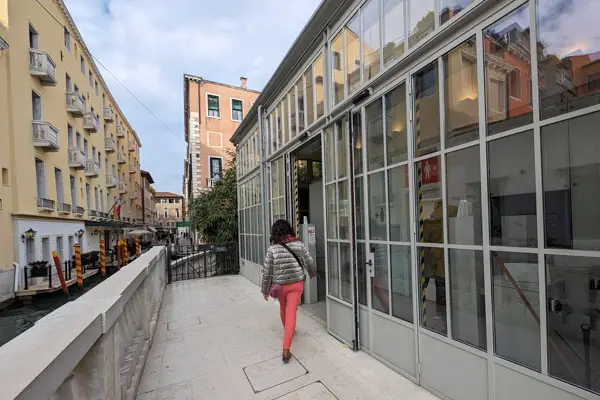
 One
of Venice' s most modern WCs is at the former Giardini Reali (Royal
Gardens), close to the
One
of Venice' s most modern WCs is at the former Giardini Reali (Royal
Gardens), close to the 
 The Santi Filippo e Giacomo public toilet is
one of the city's newest. It's tucked into a narrow street
just off the Riva degli Schiavoni, which is a busy stretch of Venice
waterfront to the east of the Doge's Palace. Look for "WC" decals and
signs in neighboring streets and follow the arrows to the servizi igienici.
The Santi Filippo e Giacomo public toilet is
one of the city's newest. It's tucked into a narrow street
just off the Riva degli Schiavoni, which is a busy stretch of Venice
waterfront to the east of the Doge's Palace. Look for "WC" decals and
signs in neighboring streets and follow the arrows to the servizi igienici.
 As
you face the buildings along the Riva, look for the Calle del Cagnoleto just
to the west of the Hotel Gabrielli. Follow the gently curving street inland
until you're forced to turn right. (The street name will change to Calle
Morosina along the way.) The Bragora WC, which once housed public showers,
is a few meters beyond the turn.
As
you face the buildings along the Riva, look for the Calle del Cagnoleto just
to the west of the Hotel Gabrielli. Follow the gently curving street inland
until you're forced to turn right. (The street name will change to Calle
Morosina along the way.) The Bragora WC, which once housed public showers,
is a few meters beyond the turn.