|
Europe >
Venice > Sightseeing > Venetian Lagoon
The Venetian Lagoon
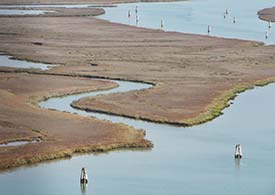
ABOVE: Low-lying land and channel markers on the
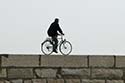
island of Torcello. INSET BELOW: Bicycling along the litorale that
separates the lagoon from the sea,
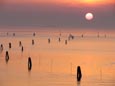
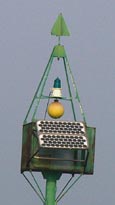
bricole near the island of San Clemente, a navigation light, a
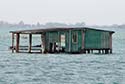
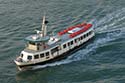
shellfishing shack near Chioggia, and an ACTV water bus from Venice to Burano.
By
Durant Imboden
 Venice is among the world's most urban cities: a crowded aggregate of houses, palazzi,
churches, squares, and other manmade structures, with few public green spaces to relieve a
landscape dominated by stone, brick, and stuccoed walls. Venice is among the world's most urban cities: a crowded aggregate of houses, palazzi,
churches, squares, and other manmade structures, with few public green spaces to relieve a
landscape dominated by stone, brick, and stuccoed walls.
So much for the obvious. What most visitors don't realize is that Venice is surrounded
by one of the most ecologically rich bodies of water in the Mediterranean: the
Laguna
Veneta, or Venetian Lagoon.
 The
Laguna is a crescent-shaped body of water between the Italian mainland and
the Adriatic sea. It lies within the arms of the Litorale Pellestrina, Litorale di Lido,
and Litorale del Cavallino. These three strips of land are broken at only three entrances
or porti along a length of some 30 miles (45 km), creating a marshy environment
that is fed by rivers yet flushed by salt water from the Adriatic. The
Laguna is a crescent-shaped body of water between the Italian mainland and
the Adriatic sea. It lies within the arms of the Litorale Pellestrina, Litorale di Lido,
and Litorale del Cavallino. These three strips of land are broken at only three entrances
or porti along a length of some 30 miles (45 km), creating a marshy environment
that is fed by rivers yet flushed by salt water from the Adriatic.
In Venice: The Art of Living, Frédéric Vitoux has this to
say about the Lagoon:
"The flow of rivers and canals mingles with the wash of the sea,
with the slow movement of the Adriatic tides, checked by peninsulas and sandbanks. The barene,
those stretches that are now submerged, now emerging, sometimes appear to twinkle on the
horizon below their fringes of weeds. The mysterious play of the currents, in a slow
process of undermining, eroding, and filling, shifts the deepest basins and brimming
lands, providential pastures for crab, shrimp, shellfish, octupus, squid, gulls, snipe,
herons, wild ducks, shoveler ducks--all the incorrigible hunters and fishers. And I
thought this was an inanimate realm."
 As Vitoux points out later in the same chapter, the Venetian Lagoon has an average
depth of just two feet. Yet within that shallow depth are any number of creatures:
anemones, crabs, mussels, limpets, barnacles, cuttlefish, squill, oysters, shrimp, and
fish that range from the tiny anchovy to eels, mullet, and sea bass up to 30 inches (75
cm) in length. And because so much food is readily available, birds such as ducks, swans,
cormorants, and spoonbills proliferate on the many abandoned or uninhabitable islands in
the lagoon. As Vitoux points out later in the same chapter, the Venetian Lagoon has an average
depth of just two feet. Yet within that shallow depth are any number of creatures:
anemones, crabs, mussels, limpets, barnacles, cuttlefish, squill, oysters, shrimp, and
fish that range from the tiny anchovy to eels, mullet, and sea bass up to 30 inches (75
cm) in length. And because so much food is readily available, birds such as ducks, swans,
cormorants, and spoonbills proliferate on the many abandoned or uninhabitable islands in
the lagoon.
Farming and fishing
Fish farming is a relatively new phenomenon in the North America, but the Lagoon's
inhabitants have practiced vallicultura for centuries. Fish farmers create a maze
of banked areas, with fish locks connecting the valle or ponds to the open
lagoon. The fish locks, or dams, are opened at certain times of the year to admit fish,
then closed until the fish are ready to return to the lagoon--at which time some are
caught and others are released to grow or reproduce in their natural environment.
 Other sea creatures are caught in the wild by a variety of techniques. Tour the Lagoon
by boat, and you'll see large square nets that are suspended from latticework towers.
Fishermen lower the nets by hand when a school of fish approaches, then raise the nets to
capture the fish. Mussel ropes are also visible in many places--just look for what appear
to be soccer standards with ropes hanging from the wooden crosspieces. Other sea creatures are caught in the wild by a variety of techniques. Tour the Lagoon
by boat, and you'll see large square nets that are suspended from latticework towers.
Fishermen lower the nets by hand when a school of fish approaches, then raise the nets to
capture the fish. Mussel ropes are also visible in many places--just look for what appear
to be soccer standards with ropes hanging from the wooden crosspieces.
Navigation amid the mud
 With the lagoon being so shallow,
vaporetti
and other larger boats must travel in dredged navigation channels to avoid run-ins with
mudflats and sandbanks. These channels are marked with clusters of wooden pilings such as the
bricola
and dama. All are numbered and marked on nautical charts, and some
have lights to make the channel boundaries visible at night. Jan Morris, travel writer and
author of The World of Venice, warns: With the lagoon being so shallow,
vaporetti
and other larger boats must travel in dredged navigation channels to avoid run-ins with
mudflats and sandbanks. These channels are marked with clusters of wooden pilings such as the
bricola
and dama. All are numbered and marked on nautical charts, and some
have lights to make the channel boundaries visible at night. Jan Morris, travel writer and
author of The World of Venice, warns:
"If you keep very close to the bricole, you are usually
safe; but not always, for sometimes their positioning is disconcertingly precise, and if
you are a few inches on the wrong side--splosh, there you are again, up to your knees in
mud, and pushing from the stern. There are said to be 20,000 bricole in the
Venetian lagoon. Some are precariously rotting, and look as though generations of
water-rats have nibbled their woodwork.
"One or two have little shrines upon them, dear to
the artists and poets of the nineteenth century ('Around her shrine no eartly blossoms
blow, No footsteps frent the pathway to and fro'). Many are used by lovers, anglers
and bathing boys as mooring piles for their boats: and one of the most curious sights of
the lagoon is offered by those gondoliers who, to while away a blazing holiday, run their
gondolas upon a convenient mud-bank and take their families paddling, leaving their
queer-prowed craft gasping and stranded on the mud, fenced by the gaunt stockade of the
bricole."
Health hazards, old and new
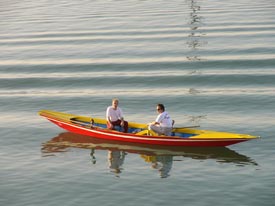
ABOVE: A boat near the island of San Clemente.
In earlier times, the Lagoon's marshy environment gave rise to malaria and other
diseases. Today, the health hazards have done a turnabout: the threat is now from man to
the Lagoon.
Industrial plants at at Marghera, on the mainland near the causeway to Venice, has
dumped chemical pollutants into the Lagoon over the last several decades. Increased
traffic by tankers and other large ships has added to the problem. Agriculture deserves
much of the blame for the algae that clogs the lagoon during the summer months, since rain
often washes chemical fertilizers into the Lagoon. This is an especially severe problem in
the marshy areas known as the laguna morta ("dead lagoon"), which
aren't rinsed by the Adriatic tides.
The Municipality of Venice is making efforts to reduce pollution, including the use of
buffer strips to capture agricultural nutrients with trees and shrubbery along the edges
of the Lagoon. Scientists are also trying to determine how a treatment plant might reduce
nitrate and phosphate deposits in the lagoon. In the meantime, the Lagoon continues to
suffer from increases in algae, mosquitoes, and other consequences of pollution
by raw sewage, industrial discharges, laundry detergents, and fertilizer runoff.
Touring the Lagoon
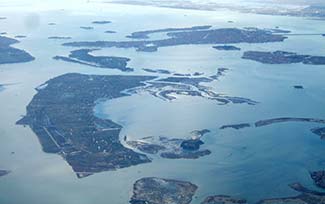
ABOVE: An aerial view of the
Venetian Lagoon.
If you fly into Venice, Italy's Marco Polo Airport and the weather is decent, you'll get a
fascinating aerial view of the Laguna Veneta--including glimpses of brick houses and
hunting lodges that sit on tiny patches of dry land at high tide.
For a more
intimate view of the Lagoon, take the
Alilaguna airport boat from airport to the Piazza San Marco instead of a
land bus or taxi, or go to Burano and Torcello on public transportation.
Read
our Venice Islands Tour article and see
our
Vaporetto Routes article to learn about water buses that serve the outer
reaches of the Lagoon.
Also see our article about Chioggia,
a fishing port at the southern end of the Lagoon, which has an historic center
with canals plus the modern beach and boating resort of Sottomarina.
-
Tip: If you plan to go
rowing or kayaking, we recommend making sure that your Hepatitis A
immunizations are up to date. (Most of Venice's sewage is discharged
directly into the city's canals, which in turn are flushed into the Venetian
Lagoon by twice-daily tides. Studies have shown unacceptable levels of
Hepatitis A virus and enteroviruses in the waters around Venice.)
About the author:
 Durant Imboden has
written about Venice, Italy since 1996.
He covered Venice and European travel at About.com for 4-1/2 years before launching
Europe for Visitors (including
Venice for Visitors) with Cheryl
Imboden in 2001. Durant Imboden has
written about Venice, Italy since 1996.
He covered Venice and European travel at About.com for 4-1/2 years before launching
Europe for Visitors (including
Venice for Visitors) with Cheryl
Imboden in 2001.
PC Magazine has called this "the premier visitors'
site for Venice, Italy." Over the years, it has helped more than 30 million
travelers. For more information, see About our site,
our Europe for Visitors
press clippings,
and
our reader testimonials.
| |
|

 Helping
30+ million
Venice travelers since 1997
Helping
30+ million
Venice travelers since 1997