|
| Venice Home | All topics |
| Where to stay | Transportation |
 Helping
30+ million
Venice travelers since 1997
Helping
30+ million
Venice travelers since 1997
Helping
30+ million
Venice travelers since 1997
|
|
VicenzaPage 3
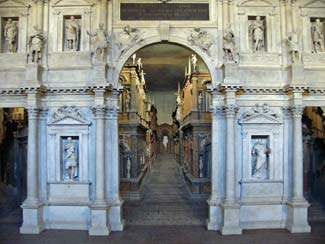
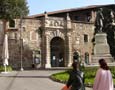
ABOVE: The stage of the Teatro Olimpico, showing the perspective stage set through the proscenium arch. INSET BELOW: Entrance and amphitheatre with loggia. Teatro OlimpicoOur own favorite "must see" attraction in Vicenza is the Teatro Olimpico, which was Andrea Palladio's final work. The theatre, built above the dungeons of a ruined castle, was begun just six months before Palladio's death in 1580 and completed by his son, Silla Palladio, and the architect Vincenzo Scamozzi in 1585. Today, it's the oldest surviving indoor theatre in Europe.
A balustrade and a row of statues line the back of the cavea, and the restored ceiling is covered with paintings from 1914 that were based on drawings from 1620.
(During our visit, a local guide explained how the illusion of distance was maintained by using smaller actors toward the back of the set.) The Teatro Olimpico also has a small bookstore and postcard stand in the handsomely decorated lobby, where you can buy the Guide Teatro Olimpico as a souvenir. The theatre is still used for plays, concerts, and festival performances. (See the Teatro Olimpico Web site). Visiting hours depend on the time of year. Next page: More sightseeing
|
|
|
| Venice for Visitors - Home | | Europe for Visitors - Home | | About our site | | Press clippings | | Testimonials |
Disclosure: Where hotel or other reservation links point to third-party booking sites, we may receive a small commission on transactions. This will not affect the rate you pay. Copyright © 1996-2026 Durant and Cheryl Imboden. All rights reserved. |
 The
Teatro Olimpico is on the Piazza Matteotti, around the corner from the tourist
office and just a few blocks northeast of the Basilica. You enter through the
brick walls of the old castle. A path leads through the Olimpico Gardens and
into the theatre building, part of which was converted from the city's former
prison.
The
Teatro Olimpico is on the Piazza Matteotti, around the corner from the tourist
office and just a few blocks northeast of the Basilica. You enter through the
brick walls of the old castle. A path leads through the Olimpico Gardens and
into the theatre building, part of which was converted from the city's former
prison.  The
centerpiece of the building is the cavea, or auditorium, with its
rectangular proscenium stage and steep rows of curved stadium-style seating.
(Some of the wooden seats are the original 16th Century panels, so be careful to
walk only on the steps unless you want to be barked at by the guard who keeps a
close watch on visitors from her seat near the door.)
The
centerpiece of the building is the cavea, or auditorium, with its
rectangular proscenium stage and steep rows of curved stadium-style seating.
(Some of the wooden seats are the original 16th Century panels, so be careful to
walk only on the steps unless you want to be barked at by the guard who keeps a
close watch on visitors from her seat near the door.)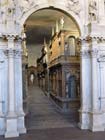 The
star attraction, however, is the stage with its permanent set, "The Seven Cities
of Thebes," which was designed by Vincenzo Scamozzi. The street behind the
central proscenium arch slants upwards, and that--combined with the alignment of
the building façades that line the street--creates an illusion of perspective as
the viewer's gaze is drawn toward a distant vanishing point.
The
star attraction, however, is the stage with its permanent set, "The Seven Cities
of Thebes," which was designed by Vincenzo Scamozzi. The street behind the
central proscenium arch slants upwards, and that--combined with the alignment of
the building façades that line the street--creates an illusion of perspective as
the viewer's gaze is drawn toward a distant vanishing point.