|
Europe >
Venice > Life & Culture > Winged lion of
St. Mark
Winged Lion of St. Mark

ABOVE: Lion on the Clock Tower, St. Mark's Square.
By
Durant Imboden
Lions are scattered about
Venice--if not in the flesh, then in countless paintings and sculptures. Mind you, there
was a time when the cats of Venice weren't limited to tabbies, as Jan Morris tells us in
A Venetian Bestiary:
"From the common cat (felis catus), the Venetians, their
horizons enlarged by their imperial and commercial adventures, turned to the lion (leo
leo), and were eventually besotted by him. Leo leo turned their heads! They
built him onto their corbels, they slipped him into their allegories, they stuck him on
gateposts, they made him the corner-stones of bridges.
"Citizens kept live lions in their
gardens, and for a time a State Lion lived in a golden cage in the Piazza; he died, it is
said, because licking the bars gave him gilt poisoning, and thereafter captive lions were
forbidden for several centuries.
"When one turned up, though, at the Venetian Carnival of
1762, Pietro Longhi showed him grandly on display, with a little dog on his back, dancing
dogs all around him, a monkey on a beam above, a fiddler fiddling, and the strolling
Venetians engrossed as ever by his presence."
Why a lion, and not a seagull?
So why does
a maritime city like Venice have a lion as its mascot? Wouldn't a seagull, a fish, or a
duck from the marshy Venetian Lagoon be a more appropriate symbol?
The answer to that question lies in the Ninth Century, when--according to legend--two
or three ambitious Chamber of Commerce types from Venice stole the remains of St. Mark the
Apostle from his tomb in Alexandria, Egypt. William Lithgow tells the story in his
"Comments on Italy" from The Rare Adventures and Painfull Peregrinations,
published in 1614 and quoted in Ian Littlewood's Venice: A Literary Companion:
"They placed the corpse in a large basket covered with herbs and swine's
flesh which the Musselmans [Muslims] hold in horror, and the bearers were directed to cry Khwazir
(pork), to all who should ask questions or approach to search. In this manner they reached
the vessel.
"The body was enveloped in the sails, and suspended to the mainmast till the
moment of departure, for it was necessary to conceal this precious booty from those who
might come to clear the vessel in the roads.
"At last the Venetians quitted the shore full
of joy. They were hardly in the open sea when a great storm arose. We are assured that S.
Mark then appeared to the captain and warned him to strike all his sails immediately, lest
the ship, driven before the wind, should be wrecked upon hidden rocks. They owned their
safety to this miracle."
After crossing the Mediterranean and cruising up the Adriatic, the graverobbers reached
Venice and handed their cargo over to the Doge. The local religious and civic authorities
quickly elected St. Mark as Venice's patron saint, and the apostle's traditional symbol--a
winged lion--became the logo of the Venetian Republic.
Here a lion, there a lion, everywhere a lion lyin'.
 One of the most famous winged lions in Venice is on the Torre dell'Orologio, the clock
tower on the Piazza San Marco. Another stands atop a column in the Piazzetta, next to the
Doge's Palace. The latter statue was hauled away to Paris by occupying Napoleonic troops
in 1797, but it was returned to Venice in 1815. One of the most famous winged lions in Venice is on the Torre dell'Orologio, the clock
tower on the Piazza San Marco. Another stands atop a column in the Piazzetta, next to the
Doge's Palace. The latter statue was hauled away to Paris by occupying Napoleonic troops
in 1797, but it was returned to Venice in 1815.
If you visit the Doge's Palace, be sure to see Capaccio's painting of 1516 that shows a
winged lion with a curiously humanoid face. The lion smiles at the observer while standing
half on the mainland, half on the lagoon with the Doge's Palace and a fleet of sailing
ships in the background.
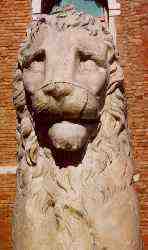 There are
plenty of other lions for leo leo lovers to enjoy. To quote A Venetian
Bestiary again, "there are lions in the middle of dreadful meals, lions having
their jaws wrenched open, lions with crowns on their heads, lions confronted by dragons,
the lion that carries Minerva side-saddle in the public gardens, the eighteenth-century
red marble lions of the Piazzetta dei Leoncini which seem specifically designed to let
children ride them, the benignly simpering Byzantine lions that sustain the Tree of Life
in the cathedral screen at Torcello." There are
plenty of other lions for leo leo lovers to enjoy. To quote A Venetian
Bestiary again, "there are lions in the middle of dreadful meals, lions having
their jaws wrenched open, lions with crowns on their heads, lions confronted by dragons,
the lion that carries Minerva side-saddle in the public gardens, the eighteenth-century
red marble lions of the Piazzetta dei Leoncini which seem specifically designed to let
children ride them, the benignly simpering Byzantine lions that sustain the Tree of Life
in the cathedral screen at Torcello."
Best of all, Venice's lions aren't real--so you can enjoy them without feeling guilty
over the fact that the object of your attentions would be happier gnawing on a zebra in
the African veldt.
Related article
Cats of Venice
Not too many years ago, there were thousands (maybe tens of
thousands) of cats in Venice. Now most of the strays have been removed to a
shelter on the Lido, but if you're eating a tuna sandwich on a park bench, you
might meet a new feline friend.
About the author:
 Durant Imboden has
written about Venice, Italy since 1996.
He covered Venice and European travel at About.com for 4-1/2 years before launching
Europe for Visitors (including
Venice for Visitors) with Cheryl
Imboden in 2001. Durant Imboden has
written about Venice, Italy since 1996.
He covered Venice and European travel at About.com for 4-1/2 years before launching
Europe for Visitors (including
Venice for Visitors) with Cheryl
Imboden in 2001.
PC Magazine has called this "the premier visitors'
site for Venice, Italy." Over the years, it has helped more than 30 million
travelers. For more information, see About our site,
our Europe for Visitors
press clippings,
and
our reader testimonials.
| 
 Helping
30+ million
Venice travelers since 1997
Helping
30+ million
Venice travelers since 1997