Capri
From:
Wind Surf Cruise Review
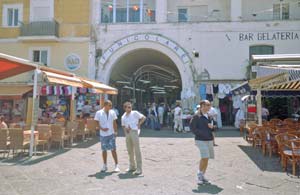
ABOVE: Tenders from the Wind Surf land
in Marina Grande, where a funicular (behind the arched doorway) provides a quick connection to Capri Town.
For most people who cruise in the Mediterranean, the island of
Capri
isn't a port of call--it's an extra-cost shore excursion from Sorrento on the
mainland, whose port is better able to handle today's large cruise ships.
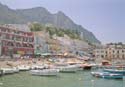 On
Wind Surf, we were more fortunate: The ship was able to cruise across
the Bay of Naples in an hour and anchor just beyond the breakwater of
Marina
Grande, the main ferry port and boat harbor for Capri. The ship arrived from
Sorrento at 8 a.m., and soon passengers were being ferried ashore by the
comfortable wooden boats of a local tender service. On
Wind Surf, we were more fortunate: The ship was able to cruise across
the Bay of Naples in an hour and anchor just beyond the breakwater of
Marina
Grande, the main ferry port and boat harbor for Capri. The ship arrived from
Sorrento at 8 a.m., and soon passengers were being ferried ashore by the
comfortable wooden boats of a local tender service.
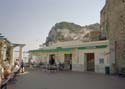 After
landing at the pier, I bought a ticket for the century-old Funiculare
that climbs the steep hillside from the port to Capri
Town. (Tip: Get your
ticket at the biglietteria a few meters away from the funiular station.
You'll probably want a ritorno or return ticket, since the walk down to
the port isn't particularly interesting.) After
landing at the pier, I bought a ticket for the century-old Funiculare
that climbs the steep hillside from the port to Capri
Town. (Tip: Get your
ticket at the biglietteria a few meters away from the funiular station.
You'll probably want a ritorno or return ticket, since the walk down to
the port isn't particularly interesting.)
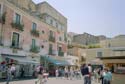 The
funicular dropped me off beneath the viewing platform at the Piazza Umberto I,
more commonly known as the Piazzetta, which was still free of crowds at
10 a.m. on a warm Saturday in May. Walking up the stairs brought me to a
spectacular overlook with views of the port, the rocky heights of Mt. Solaro,
and villas (mostly white) scattered across the plateau and hillsides overlooking
the sea. The
funicular dropped me off beneath the viewing platform at the Piazza Umberto I,
more commonly known as the Piazzetta, which was still free of crowds at
10 a.m. on a warm Saturday in May. Walking up the stairs brought me to a
spectacular overlook with views of the port, the rocky heights of Mt. Solaro,
and villas (mostly white) scattered across the plateau and hillsides overlooking
the sea.
 Once
I'd bought a map and guidebook from one of the tourist shops on the fringes of the
medieval district, I struck out in the direction of Villa Jovis, the
ruins of a villa complex where the Emperor Tiberius ruled he Roman Empire from
27 to 37 A.D. The 20-minute uphill walk took me along pedestrian paths that were
filled mostly with locals going into town for their weekend shopping. Along the
way, I passed a public toilet and a attractive, naturally landscaped park where
an old man had set up a display of tourist-office maps in several languages with
a donation box containing small coins. Once
I'd bought a map and guidebook from one of the tourist shops on the fringes of the
medieval district, I struck out in the direction of Villa Jovis, the
ruins of a villa complex where the Emperor Tiberius ruled he Roman Empire from
27 to 37 A.D. The 20-minute uphill walk took me along pedestrian paths that were
filled mostly with locals going into town for their weekend shopping. Along the
way, I passed a public toilet and a attractive, naturally landscaped park where
an old man had set up a display of tourist-office maps in several languages with
a donation box containing small coins.
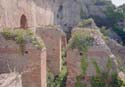 Villa
Jovis is built around the summit of Mt. Tiberius, the highest point in the
eastern section of Capri, and it's worth visiting both for the ruins and the
fine panoramic views of the Golfo di Napoli and the Golfo di Salerno. Villa
Jovis is built around the summit of Mt. Tiberius, the highest point in the
eastern section of Capri, and it's worth visiting both for the ruins and the
fine panoramic views of the Golfo di Napoli and the Golfo di Salerno.
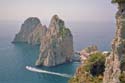 On
my way back to Capri town, I detoured to the Natural Arch, the three
world-famous rocks known as the Faglioni (photo at left), and the
Grotto of Matermania, a trip that required climbing up and down hundreds of
stone steps on the cliffs above the island's southeastern coast. On
my way back to Capri town, I detoured to the Natural Arch, the three
world-famous rocks known as the Faglioni (photo at left), and the
Grotto of Matermania, a trip that required climbing up and down hundreds of
stone steps on the cliffs above the island's southeastern coast.
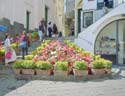 Finally
I returned to the Piazzetta by way of the Via Tragara (where I bought an icy
granita di limone from a street vendor) and the Via Vittorio Emanuelle
with its upscale hotels and elegant shops. Finally
I returned to the Piazzetta by way of the Via Tragara (where I bought an icy
granita di limone from a street vendor) and the Via Vittorio Emanuelle
with its upscale hotels and elegant shops.
Shore excursions. Wind Surf offered a pair of tours during its
seven-hour visit: "A Taste of Capri," a 4-1/2-hour excursion to
Anacapri with a
visit to Capri on the way back to the ship, and "The Blue Grotto," a 1-1/2-hour
boat ride to the mysteriously-lit cavern (technically known as a "Karst cavity")
that has attracted foreign tourists since at least the 17th Century. Both tours
were popular. Several passengers mentioned being thrilled by the chairlift ride
to the top of Mt. Solaro (589m or 19,33 ft.), the highest point on the island,
which was one of the sightseeing choices available to participants in the Taste
of Capri tour.
Next page:
Rome (Civitavecchia)
| 

