Trapani, Sicily
From:
Wind Surf Cruise Review
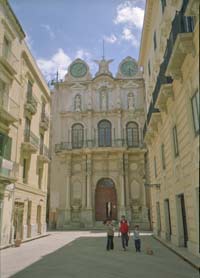
ABOVE: Three boys and a dog stroll in Trapani's historic quarter.
Trapani is a bustling port city of 80,000 people near the northwestern
corner of Sicily. It's also the birthplace of Alessandro Scarlatti and the port for Marsala (home of Marsala wine), and
it was a host city for the 2005 America's
Cup sailboat races.
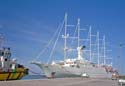 Wind
Surf tied up at the maritime station in the city center, next to a row of
sightseeing boats and to the Isole Egadi, or
Egadi Islands, which are visible
from the waterfront. Wind
Surf tied up at the maritime station in the city center, next to a row of
sightseeing boats and to the Isole Egadi, or
Egadi Islands, which are visible
from the waterfront.
From the pier, it was easy to reach Trapani's
Centro Storico or historic center:
I just crossed the road, ducked into the nearest side street, and there I was.
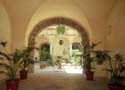 The
old town reminded me of a smaller and quieter Seville with its ancient narrow
streets, wrought-iron lamps, and shuttered stuccoed buildings with courtyards. The
old town reminded me of a smaller and quieter Seville with its ancient narrow
streets, wrought-iron lamps, and shuttered stuccoed buildings with courtyards.
Clothing shops dotted the Via Torrearsa and adjacent streets, with some of
them selling evening gowns and other high-priced goods. Other shops catered to
the young market (every female under 30 seemed to be wearing the latest style of
jeans, in contrast to the surprising number of dapper-looking elderly gentlemen
who sported well-cut jackets or double-breasted suits). Churches are also in
abundance, but most were closed, although I did manage to visit one church that
displayed the nicely dressed skeletons of two long-dead religilus personages in
glass cases.
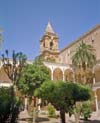 I
wanted to see the Museo del Pepoli, which is housed in the 13th Century
Carmelite Monastery of the Annunziata just beyond the city center. After
buying a map at a newsstand, I headed east along the Via Giovanibattista
Fardella until I reached the Via Conte Agostino Pepoli, where a right turn led
me to the museum. Walking time was about 30 minutes. I
wanted to see the Museo del Pepoli, which is housed in the 13th Century
Carmelite Monastery of the Annunziata just beyond the city center. After
buying a map at a newsstand, I headed east along the Via Giovanibattista
Fardella until I reached the Via Conte Agostino Pepoli, where a right turn led
me to the museum. Walking time was about 30 minutes.
The museum was easily worth the stroll, and the admission price
was reasonable. The former monastery is attractive with its
cloistered courtyard, grand staircase, and airy, high-ceilinged rooms.
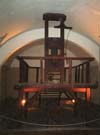 Exhibits
are eclectic, ranging from stone funeral tablets with Arabic inscriptions to a
guillotine on a scaffold with a coffin awaiting the victim underneath. Upstairs,
there are outstanding collections of painted tile floor and wall scenes, 17th
and 18th Century figurines, jewelry and liturgical objects made with coral, and
lovely tableaux made with corals, shells, human and animal figurines, and props
such as a miniature castle. Exhibits
are eclectic, ranging from stone funeral tablets with Arabic inscriptions to a
guillotine on a scaffold with a coffin awaiting the victim underneath. Upstairs,
there are outstanding collections of painted tile floor and wall scenes, 17th
and 18th Century figurines, jewelry and liturgical objects made with coral, and
lovely tableaux made with corals, shells, human and animal figurines, and props
such as a miniature castle.
- Tip: If you
go to the museum, also visit the adjoining
Santuario dell'Annunziata.
Behind the Gothic façade is a 14th Century church that got a Baroque
refit in the 1700s, and behind that is the smaller
Capella della Madonna,
an over-the-top 16th Century chapel with a marble statue of the Madonna.
During my visit, I was surprised to see a fair number of worshippers or
pilgrims meditating in the chapel, including some men who looked far too
young to be venerating the Madonna when they could have been out riding
Vespas or wooing their Sicilian sweethearts.
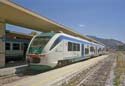 After
touring the museum and sanctuary, I returned to town by way of a public park
(which included a modest aviary) and the railway station (where a train was
about to leave for Palermo). After
touring the museum and sanctuary, I returned to town by way of a public park
(which included a modest aviary) and the railway station (where a train was
about to leave for Palermo).
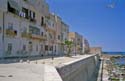 I
later explored the northern shore of the old town, where a spit of land
contained a hidden beach with a pretty little garden (and two bikini-clad
beauties at the time of my exploration) and the Torre di Ligny, one of
several fortresses that once protected Trapani's harbor. I
later explored the northern shore of the old town, where a spit of land
contained a hidden beach with a pretty little garden (and two bikini-clad
beauties at the time of my exploration) and the Torre di Ligny, one of
several fortresses that once protected Trapani's harbor.
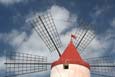 Wind
Surf offered two shore excursions during our visit to Trapani: one to the
Temple of Segesta, an archaeological site more than 2,400 years old, and the
other to the village of Erice, which has panoramic views, medieval
architecture, and shopping. (Excursions from Trapani normally include views of
the windmills that are famous in this region of Sicily.) Wind
Surf offered two shore excursions during our visit to Trapani: one to the
Temple of Segesta, an archaeological site more than 2,400 years old, and the
other to the village of Erice, which has panoramic views, medieval
architecture, and shopping. (Excursions from Trapani normally include views of
the windmills that are famous in this region of Sicily.)
Good English-language tourist
information for Trapani is in short supply, but you'll find online hotel listings and
other data in Italian at the
Trapani Tourist Office. And if you're curious about harbor facilities,
see the bilingual Port of Trapani
site.
Next page:
Amalfi
Windmill photo copyright ©
Steve Geer.
| 

