| Germany Index | Europe for Visitors |
 "Best
of the Web" - Washington Post
"Best
of the Web" - Washington Post
"Best
of the Web" - Washington Post
|
|
Zeppelin Museum Friedrichshafen
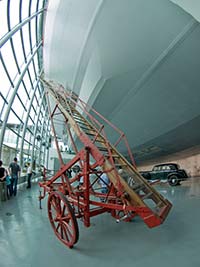
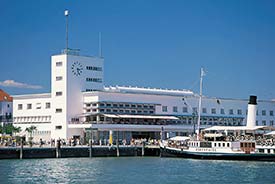
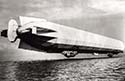
ABOVE: The Zeppelin Museum is on Friedrichshafen's waterfront promenade, facing the harbor on Lake Constance (a.k.a. the Bodensee). INSET BELOW: A 1908 Zeppelin, and a replica of the Hindenburg's interior.
Today, most people regard Zeppelins as a short-lived phenomenon that ended with the explosion of the Hindenburg in Lakehurst, New Jersey in 1937. In reality, the rigid aluminum-framed airships were in service for nearly 40 years, with their development culminating in the sister ships Hindenburg and Graf Zeppelin II, which carried up to 50 passengers and a crew of 40 in transatlantic service between Germany and the United States.
Scores of Zeppelin airships were subsequently built by Count Ferdinand von Zeppelin's company, which was based in Friedrichshafen, Germany on the lake's northern shore. The Zeppelin era came to an end in 1940, when the German government had the airships broken up for scrap metal. Today, the Zeppelin's technology and history are on display at the Zeppelin Museum Friedrichshafen, which occupies the city's restored Hafenbahnhof (Harbor Railway Station) from the 1930s. The museum's exhibition space (43,000 square feet or 3,995 m²) offers historic photos, objects, artworks, a movie theatre with a Zeppelin documentary, and--most important--a partial life-size replica of the Hindenburg. This simulated airship has a cutaway hull section, passenger cabins, and public rooms that suggest what it was like to enjoy a three-day transatlantic crossing at a cost of 1,000 Reichsmark (about €30,000 in today's currency). Visitor information
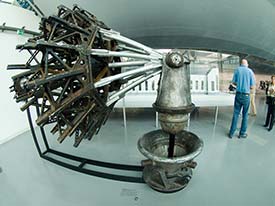
ABOVE: The nose section from a Zeppelin's frame, showing the anchoring device that fits into a receptacle on a mooring pylon. Location: The Zeppelin Museum is a large white 1930s-style building at Seestrasse 22, close to the car-ferry piers, bus depot, and Hafenbahnhof railroad station in downtown Friedrichshafen. For a map and directions in English, see the museum's Location and Direction page. Hours: May-October: 9 a.m. - 5 p.m. daily. November-April: 10 a.m. - 5 p.m. Tuesday through Sunday. For holiday exceptions to the hours above, and to check ticket prices, see the museum's Opening hours and prices page. (Tickets are available online or at the museum.) Individual tours: The museum offers a smartphone mediaguide in various languages, along with video guides for children and hearing-impaired visitors and children. (To use the guides, you scan QR codes as you explore the museum.) Web links:
Zeppelin Museum Wikipedia:
Zeppelin Zeppelin NT YouTube:
Hindenburg (1937) More photos from the Zeppelin Museum:
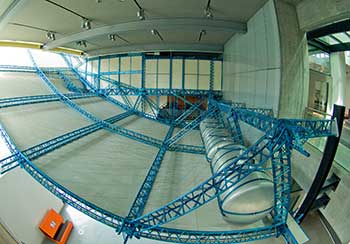
A highlight of the Zeppelin Museum Friedrichshafen is a reconstruction of a 33-meter (108-foot) section of LZ 129, the Hindenburg. The airship replica is on two floors: On the ground floor, shown here, you can look up at the airship's exterior, which consists of five layers of cotton-linen fabric with five layers of paint. (The top layer of fabric is coated with heat-reflecting aluminum particles.)
Stairs lead to an observation platform where you can see the Hindenburg replica's aluminum frame, the coated-fabric skin, and the space that contained the bags of hydrogen gas. The Hindenburg was designed for helium gas, but the United States of America--which controlled the world's supply of helium--refused to sell the gas to Germany, forcing the Zeppelin company to rely on lighter but more flammable hydrogen.
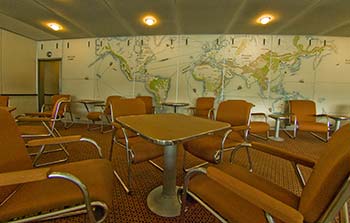
Upstairs, inside the Hindenberg replica, you can see the lounge where the airship's 40 passengers socialized during the three-day transatlantic crossing.
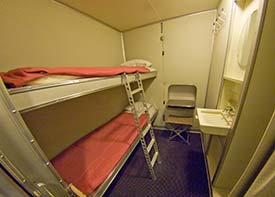
The Hindenburg's staterooms were small but comfortable, with far more privacy and space than today's first-class airline seat pods offer.
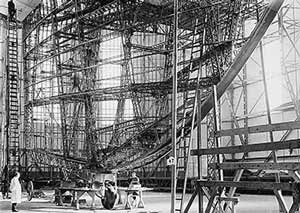
This photo from the museum's collection shows a Zeppelin under construction. (The aluminum girders were extremely light. During your visit to the museum, you can pick up a section of girder and marvel at how little it weighs.)
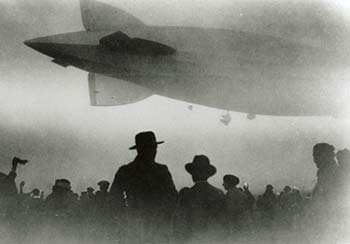
Another historic photo shows a crowd watching the arrival or departure of a Zeppelin airship in 1924.
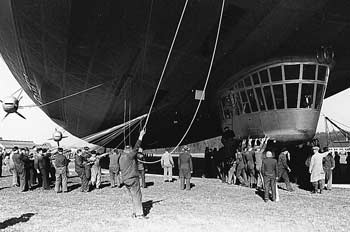
This is one of our favorite images from the Zeppelin Museum's photo collection: It shows that each landing was a community event, with residents of Friedrichshafen grabbing ropes and helping the ground crew to moor the arriving airship.
About the author:
After 4-1/2 years of covering European travel topics for About.com, Durant and Cheryl Imboden co-founded Europe for Visitors (now including Germany for Visitors) in 2001. The site has earned "Best of the Web" honors from Forbes and The Washington Post. For more information, see About Europe for Visitors, press clippings, and reader testimonials. |
|
|
| Germany for Visitors - Home | | Europe for Visitors - Home | | About us | | Press clippings | | Testimonials | Copyright © 1996-2024 Durant and Cheryl Imboden. All rights reserved. |

 The
first Zeppelin, the LZ1, had its maiden flight over the Bodensee (Lake
Constance) in 1900--some three and a half years before the Wright Brothers flew
their way into history in North Carolina.
The
first Zeppelin, the LZ1, had its maiden flight over the Bodensee (Lake
Constance) in 1900--some three and a half years before the Wright Brothers flew
their way into history in North Carolina.