|
| Paris Home | Sightseeing |
| Where to Stay | Transportation |
 Save
on car rental with short-term leasing
Save
on car rental with short-term leasing
Save
on car rental with short-term leasing
|
|
Opéra Garnier (Palais Garnier)
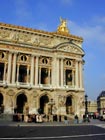
ABOVE: The trompe d'oeil curtain of the Opéra Garnier (which is really a flat curtain with painted folds). INSET BELOW: Views of the main façade and its statuary.
The Opéra Garnier or Palais Garnier, still known to many as the "Paris Opera," was the world's largest theatre and opera house when it opened on January 5, 1875. The cavernous building, designed by Charles Garnier, was one of 171 proposals submitted in an architectural competition in 1861. The Palais Garnier took 14 years to build, with its completion being delayed by money troubles, the Franco-Prussian War (when the building was used as a warehouse), and a fire that gutted the interior and killed a fireman in 1873.
Today, however, opera (in the tradition of Elvis) has left the building: The Opéra Garnier is now used mostly for ballet and modern dance, with grand opera taking place at the modern Opéra Bastille, which opened in 1989. The best way to visit the Opéra Garnier is to attend a performance. If that doesn't fit your schedule, you can visit the building or take a tour. There's also a museum with impressive displays of costumes, drawings, and set models. Note: In case you were wondering, there really is a man-made lake beneath the Opéra Garnier, though no phantoms have been spied recently. The subterranean pond is now a reservoir and training facility for the city's pompiers-sapeurs, or firefighters. Opéra Garnier visitor information
ABOVE: The Place de l'Opéra and Palais Garnier at night. Hours: Usually 10 a.m. until late afternoon, with closing time depending on the season and whether a performance is scheduled. We suggest allowing at least an hour, and preferably longer, for your visit. Admission: €12 to €14 for adults, depending on exhibition schedule. Rdduced rates for students, children under 10, and other special groups. You can buy tickets in Paris or book online. Tours: Guided tours are offered in English sevedral times a week. See the Web site (link below) for a current schedule and booking information. Audioguides are available for a fee. Location: The Palais Garnier occupies the north side of the Place de l'Opéra in the 9th arrondissement. It faces the Avenue de l'Opéra, which angles through the 1st and 2nd arrondissements until it reaches the Louvre. Transportation: The closest Métro station is Opéra, which you can reach on Lines 3 (pea-green on the official RATP Métro map), 7 (pink), and 8 (lavender). The nearest RER stop is Auber, on Line A. Bus lines also serve the area; routes are shown on the RATP Paris Tourisme map and the pocket-size Plan de Poche map, which are free at Métro and RER stations. Nearby attractions: The Opéra Garnier is close to Fragonard's Perfume Museum (free admission) and Paris Story, an audiovisual show that may be of interest if it's raining or your feet need a rest. For more information: See the Palais Garnier's multilingual visitor pages. More Opéra Garnier Photos:
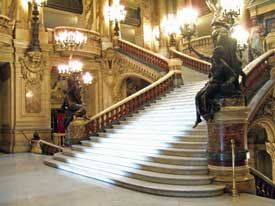
ABOVE: A view of the grand staircase in the Palais Garnier. In this section, we've provided a random assortment of captioned photographs from the Palais Garnier. If you'd like pictures for your own use, visit the gift shop on the ground floor. It has an excellent selection of postcards and an inexpensive but beautifully illustrated souvenir book, Palais Garnier: National Opera of Paris from the Éditions du Patrimoine series published by Monum, a.k.a. the Centre des Monuments Nationeaux in France.
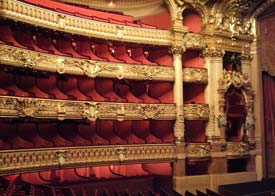
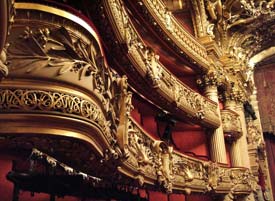
The interior of the auditorium is lined with gilded boxes on the dress circle and balcony levels. To see the auditorium, head to the top of the grand staircase and look for wooden doors that lead into the boxes. Several boxes are usually left open for visitors.
The heavily gilded boxes are supported by a cast-iron structure. (Indeed, most of the auditorium is made of cast iron, with gold, velvet, and marble decoration hiding the structural underpinnings.)
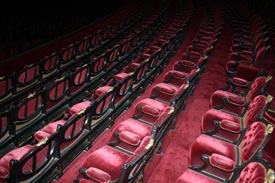
Below you, on the orchestra level, are curving rows of seats. (The opera's seats have been red from the beginning, on the theory that red is flattering to women's complexions.)
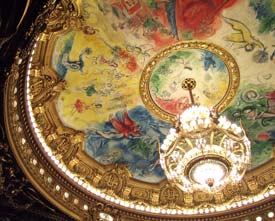
Look up, and you'll see the ceiling that Marc Chagall painted in 1964 at the request of André Malraux, who was France's minister of culture in the Gaullist era.
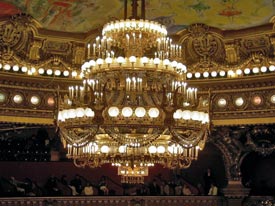
In contrast to Chagall's painting, the bronze-and-glass chandelier is original. The seven-ton fixture was designed by Charles Garnier and contains 340 lights.
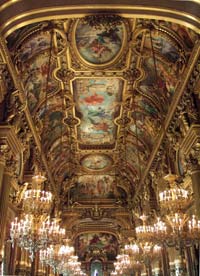
The Palais Garnier's most florid decoration is outside the auditorium, in the grand foyer. This long, narrow room is covered with 33 paintings over 500 m² or nearly 5,400 square feet, which the artist Paul Baudry completed over a nine-year period. Nearby, various rotundas, galleries, and smaller foyers keep guests occupied during intermissions.
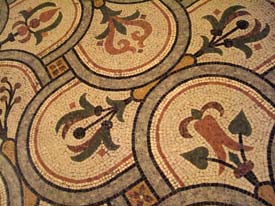
As you wander through the building, take time to enjoy the mosaic floors. (Some parts of the Palais Garnier are paved with inlaid marble; the building's interior uses 24 varieties of marble from different areas of Europe.)
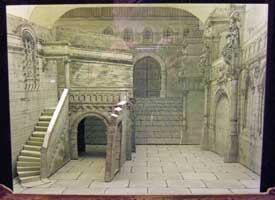
The Palais Garnier also has a museum and library (no extra charge) with set models, drawings, and costumes from the Opéra's long history. The museum's entrance is on the orchestra level, facing the left side of the audiorium. (Some of our favorite costumes in the museum were designed by Christian Lacroix, the Parisian couturier.)
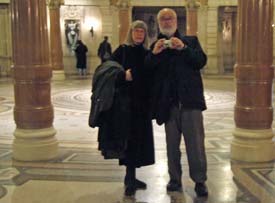
Tip for tourists without selfie sticks: For an inexpensive souvenir of the Opéra Garnier, turn off your camera's flash and take a picture of yourself (or yourselves) in the mirrors on the walls and ceiling of the season ticket-holders pavilion beneath the auditorum. This rotunda, which feels like an elegant crypt, is behind the grand staircase and to your right. About the author:
After 4-1/2 years of covering European travel topics for About.com, Durant and Cheryl Imboden co-founded Europe for Visitors (including Paris for Visitors) in 2001. The site has earned "Best of the Web" honors from Forbes and The Washington Post. For more information, see About our site, press clippings, and reader testimonials.
1st inset photo © iStockphoto.com/Brian Kelly (top)
|
|
|
|

 The Palais Garnier wasn't an immediate hit with critics or with
the public: Its Second Empire grandiosity was considered over the top by some.
Empress Eugénie, wife of the third Napoleon, is
reported to have asked Garnier: "Whatever is this style? It's not a style! It's
neither Greek, nor Louis XVI, nor even Louis XV!" Garnier is said to have
replied, "No, those styles are outdated. It's Napoleon III. And you complain?"
The Palais Garnier wasn't an immediate hit with critics or with
the public: Its Second Empire grandiosity was considered over the top by some.
Empress Eugénie, wife of the third Napoleon, is
reported to have asked Garnier: "Whatever is this style? It's not a style! It's
neither Greek, nor Louis XVI, nor even Louis XV!" Garnier is said to have
replied, "No, those styles are outdated. It's Napoleon III. And you complain?"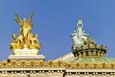 Whatever the building's style, it
was well-suited to opera, where architectural excess goes hand in hand with
extravagant costumes, florid music, and the oversized egos of singers and
wealthy opera patrons.
Whatever the building's style, it
was well-suited to opera, where architectural excess goes hand in hand with
extravagant costumes, florid music, and the oversized egos of singers and
wealthy opera patrons.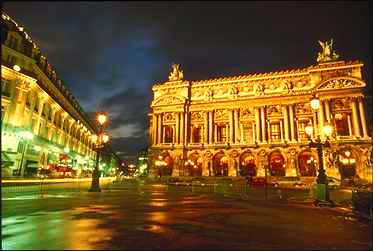
 Durant Imboden