Europe
>
Paris >
Transportation > Taxis
Paris Taxis
How to use cabs in Paris, France.

ABOVE: A Paris taxi does double duty as a mobile
billboard in the 6th arrondissement.
By
Durant Imboden
First,
a confession: We don't use Parisian taxis ourselves--not merely out of
thrift, but because we'd rather walk or take the Métro, and traveling light with
wheeled luggage makes cabs unnecessary most of the time.
Just as important,
using taxis can be frustrating (not to mention environmentally insensitive) in a
city like Paris where traffic is often congested.
Still, taxis do run 24 hours a day, unlike most forms of public
transportation in Paris. And when you need a taxi, it's nice to know how the system works.
Here, then, is a basic introduction to les taxis parisiens:
-
Paris and its suburbs have nearly 18,000 licensed taxis. Usually you
won't have a problem finding a cab, as long as it isn't lunchtime,
dinnertime, or rush hour on a rainy day. If you do require transportation at such
times, don't want until the last minute to get a cab.
-
You can hire a taxi at any of the nearly 500 official cab stands or taxi
ranks, by waving down a taxi from the curb, or by telephoning a cab stand or radio
dispatcher. (Warning: If you call for a taxi, the meter will start when the
driver heads for your pickup location--not after you get in the cab.)
-
Fares aren't cheap, but they aren't too bad with within the
city. Longer trips, however, can be
expensive: The fare from Charles de De Gaulle Airport to a hotel in central
Paris is €56 to
€65, depending on location.
You'll normally be charged extra for luggage, baby strollers, and other bulky items,
although wheehclairs are free.
-
Be prepared to pay in cash, since drivers aren't required to
accept credit or debit cards. (If the driver does take cards, the cab will
have a sign in the back side window.)
-
It's illegal for taxis to pick up passengers in the street within 50
meters of a taxi stand. If you're near a taxi stand, walk to the stand and take the first cab in line.
-
Hire only licensed taxis--and if you're ripped off by an unlicensed
cabbie, don't expect sympathy from the police.
Finally, here's how to know whether a taxi is vacant or
unavailable:
 
-
A taxi's white roof
sign is illuminated with green LEDs when the cab is vacant, and with
red-amber LEDs if
the cab is occupied or on its way to pick up a customer.
-
The three small lights below the rooftop taxi sign are "fare
lights" that show police which zone fare is being charged.
For more information on using taxis in Paris (including a list
of taxi stands, a fare calculator, and other third-party resources), see the
annotated Web links below.
Paris Taxi links
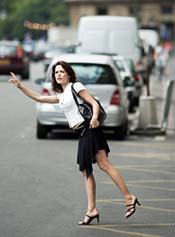
ABOVE: You can hail a
cab in Paris, but walking to the nearest taxi stand may be quicker and
easier. (A taxi stand or rank is easy to recognize: You'll see a line of
cabs and the word "TAXI" in white on a blue sign.)
G7
The largest taxi company in Paris represents some 3,000 drivers. It accepts
telephone calls and online bookings.
World
Taximeter: Paris
Calculate an estimated fare before you call for a cab. (You can enter street
addresses or pick from a list of airports, train stations, and tourist
landmarks.)
Taxi-Paris.net
This site includes a list of Parisian
taxi ranks (a.k.a. cab
stands) with phone numbers, taxi
fares and surcharges, and other useful information.
About the author:
 Durant Imboden
is a professional travel writer, book author, and editor who focuses on European
cities and transportation. Durant Imboden
is a professional travel writer, book author, and editor who focuses on European
cities and transportation.
After 4-1/2 years of covering European travel topics for About.com, Durant and
Cheryl Imboden co-founded Europe for Visitors (including Paris for Visitors) in
2001. The
site has earned "Best of the Web" honors from Forbes and The
Washington Post.
For more information, see
About
our site,
press clippings, and
reader
testimonials.
Top, 1st inset, 3rd inset photos copyright © Paris
Tourist Office.
Photographer: Jacques Lebar.
4th inset photo copyright © Alexander Rybakov.
| |
|

 Save
on car rental with short-term leasing
Save
on car rental with short-term leasing