| Switzerland & Austria | Europe |
 Save
on car rental with short-term leasing
Save
on car rental with short-term leasing
Save
on car rental with short-term leasing
|
Cresta Run, St. Moritz
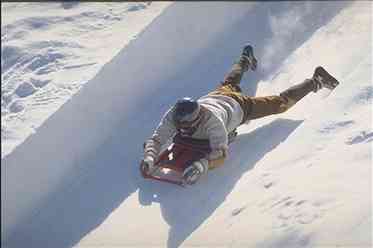
ABOVE: A rider brakes by sliding back on the sled and digging in his toe cleats. To most people (especially in North America), the word "toboggan" evokes memories of flat-bottomed wooden sleds bouncing down a snow-covered hill in a neighborhood park. At the Cresta Run in St. Moritz, Switzerland, the term has an altogether different meaning: it's used to describe a steel "skeleton sled" that may reach speeds of nearly 80 mph (129 km/h) over its 3/4-mile or 1.2 km course from St. Moritz to the neighboring village of Celerina. A Victorian legacyThe Cresta Run had its beginnings in the autumn of 1884, when George Robertson and Charles Digby-Jones of the British winter residents' Outdoor Sports Committee staked out a course from above the Hotel Kulm to the outskirts of Celerina. When the snows arrived in November, the five committee members went to work. Their labors are described in The Cresta Run 1885-1985, the centenary anniversary book that Roger Gibbs wrote for the St. Moritz Tobogging Club:
In early January, the new Run's builders invited the British community in Davos, Switzerland to send over ten tobogganists for a "Grand National" competition, thereby starting a racing tradition that has been broken only by two World Wars.
A century of evolutionAs the years passed, the Cresta Run's toboggans evolved from tall wooden sleds of the classic European design into low, streamlined platforms designed to reduce wind resistance and provide greater stability in tight corners. The riding technique also changed from sitting upright to lying face down with the head forward, using body position and toe cleats to control direction, speed, and braking. (The sliding seat was added in 1902, but some of today's fastest riders are again using fixed sleds.) Nowadays, the Cresta's skeleton toboggans resemble mechanics' creepers with steel tubing underneath. Athletic "tobogganers" in sleek wet suits and crash helmets grasp handles near the front of the sled, lying flat or pushing themselves upwards as necessary to negotiate the straightaways and treacherous curves of a course that drops 514 feet (157 meters) and has an average gradient of 13 per cent. A skilled toboganner can finish the 3/4-mile run in less than a minute, for an average speed of more than 45 miles (72 kilometers) an hour.
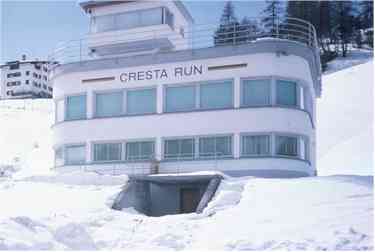
ABOVE: The Cresta Run's clubhouse is located at Junction, below the aptly named Church Leap. A ride for the fearlessIn The Cresta Run 1885-1985*, Roger Gibbs describes a ride down the ice chute on a skeleton toboggan:
And now, it's your turn.You, too, can risk life and limb on the Cresta Run--providing you're in St. Moritz during the season (which normally runs from just before Christmas through the end of February), are a male over 18 years of age, and can afford the CHF 600 fee. (Women are out of luck--the SMTC is a bros' club.) Your payment entitles you to a beginners' booklet, a quick introduction to the basics of skeleton toboganning, and up to five rides down the Cresta Run with equipment supplied by the club. Related Web site and articleSt. Moritz Tobogganing Club Winter Resort Report: St. Moritz europeforforvisitors.com * The Cresta Run, 1885-1985 About the author:
After 4-1/2 years of covering European travel topics for About.com, Durant and Cheryl Imboden co-founded Europe for Visitors in 2001. The site has earned "Best of the Web" honors from Forbes and The Washington Post. For more information, see About Europe for Visitors, press clippings, and reader testimonials. |
|
|
| Europe for Visitors - Home | | Contact information, disclosures, audience | Disclosure: Where hotel or other reservation links point to third-party booking sites, we may receive a small commission on transactions. This will not affect the rate you pay. Copyright © 1996-2026 Durant and Cheryl Imboden. All rights reserved. |