| Switzerland & Austria | Europe |
 Save
on car rental with short-term leasing
Save
on car rental with short-term leasing
Save
on car rental with short-term leasing
|
St. Moritz, Switzerland
ABOVE: An evening view of St. Moritz Bad (left) and Dorf (right), with the frozen lake between.
St. Moritz (or San Murezzan to the Romansh-speaking natives) has been an international resort for as long as anyone can remember. In the Middle Ages, it was known for the healing powers of its mineral springs; later, toward the end of the 19th Century, it became a sunny winter refuge for bedrizzled English aristocrats.
The resort is made up of two areas that are separated by a mile of lake shore:
(Note: Frequent shuttle buses connect the two half-villages, and it's easy to walk from one to the other along the main road or lakeside paths.) Hotels and rentalsAlthough it's possible to rent apartments and villas, the quintessential St. Moritz experience is in the resort's traditional hotels. These range from the Suvretta House, Carlton, Kulm, and Badrutt's Palace at the upper end of the scale to cozy rural inns like the Landgasthof Meierei (an easy walk from town along the lake's northern shore, and a great place for dinner).
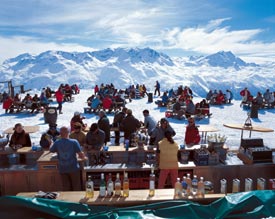
ABOVE: A ski bar on the Corviglia slopes above St. Moritz. Practical informationDining and entertainment St. Moritz is the kind of resort where you're likely to have at least one major meal besides breakfast in your hotel. Still, there are plenty of restaurants to choose from in a variety of price ranges. The most expensive are in Dorf; the middle-class establishments are mostly along the road between Dorf and Bad, where you'll also find supermarkets. As for nightlife, there are plenty of clubs in town that range from expensive to out of sight. If money is a concern and you love the apr�s-ski life, Club Med's all-inclusive resorts (Roi Soleil and Reine Victoria) are worth considering. Finally, the town has an Engadiner Museum that's worth visiting if you're even remotely interested in the Engadine region's history, life, and culture. Skiing St. Moritz has skiing for every taste and skill level. From Dorf, you can take a funicular and cablecar up Corviglia, which has plenty of intermediate slopes. (I once stood at the top of Corviglia and watched a mother head down a roadlike piste with two tots in tow.) If you're a cross-country skier, you'll be delighted by the 150 km (100 miles) of groomed XC trails in the area. You can ski from one village to the next, returning over a different trail, by bus, or on one of the many local trains. Equipment rentals are available at the cross-country ski center in St. Moritz Bad, where you can also get expert waxing for a small fee. Getting to St. Moritz From Zürich Airport, St. Moritz is about four hours by railroad. You'll need to change trains at Zürich Hauptbahhof (the main station) and again at Chur, where you transfer to a narrow-gauge Rhaetian Railway line. You can also drive to St. Moritz, but the roads can be tricky in winter and you may need tire chains.
Web linksArticles at Switzerland for Visitors Cresta Run Rescue 117 Allegra! (Introduction to Romansh) Tourist information St. Moritz About the author:
After 4-1/2 years of covering European travel topics for About.com, Durant and Cheryl Imboden co-founded Europe for Visitors in 2001. The site has earned "Best of the Web" honors from Forbes and The Washington Post. For more information, see About Europe for Visitors, press clippings, and reader testimonials. Photo: Swiss-image.ch. |
|
|
| Europe for Visitors - Home | | Contact information, disclosures, audience | Disclosure: Where hotel or other reservation links point to third-party booking sites, we may receive a small commission on transactions. This will not affect the rate you pay. Copyright © 1996-2026 Durant and Cheryl Imboden. All rights reserved. |

 The sporting life has been a part of St. Moritz since the first British visitors staged
toboggan races on the steep village streets a hundred years ago. Two Winter Olympic games
have taken place here (in 1928 and 1948), and today's winter sports include alpine and
cross-country skiing, figure skating, hockey, curling, bobsledding, skeleton tobogganing
on the Cresta Run, ski paragliding, a golf tournament on the frozen lake, polo, greyhound
racing, and horse racing.
The sporting life has been a part of St. Moritz since the first British visitors staged
toboggan races on the steep village streets a hundred years ago. Two Winter Olympic games
have taken place here (in 1928 and 1948), and today's winter sports include alpine and
cross-country skiing, figure skating, hockey, curling, bobsledding, skeleton tobogganing
on the Cresta Run, ski paragliding, a golf tournament on the frozen lake, polo, greyhound
racing, and horse racing.