| Switzerland & Austria | Europe |
 Save
on car rental with short-term leasing
Save
on car rental with short-term leasing
Save
on car rental with short-term leasing
|
|
SchwyzertüütschSwiss-German Language
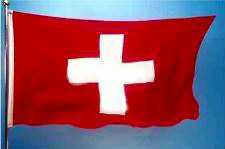
ABOVE: The Swiss flag, or "Faane" in Zürich dialect.
Q. What's the most popular language in Switzerland? (Hint: It isn't German.) You've taken a Community Ed course in German. You've listened endlessly to your Deutsch in 30 Minutes CD and and memorized the "Useful Expressions" chapter in your Berlitz pocket phrasebook. You step off the plane in Zürich, line up at the immigration counter, and proudly recite "Guten Morgen" to the official behind the glass. He responds with a muttered "Grüezi" or "Guete Tag" as he hands back your passport. Congratulations--you've survived your first encounter with the dialect known as Schwyzertüütsch, Schweizerdeutsch, or Züritüütsch and a host of other local or cantonal names. It's all in the throat.If you've ever heard the word "chutzpah" pronounced correctly, you'll recognize the most characteristic sound of Swiss-German dialect. It's the "chhhhhh" or "kkkkkk" noise that baseball players make before they deposit tobacco juice on the infield grass. Go ahead--try to pronounce the name of Zürich's delectable cheese pastry, Ch�s-Chüechli, without losing your dignity. You'll understand why humorist George Mikes once said of Swiss-German dialect, "it is as though the Venus of Milo were to belch suddenly in public. One cannot imagine the Mona Lisa speaking Schwyzerdeutsch." But is it German?Yes and no--or, as a Swiss might say, "villicht." Schweizerdeutsch is a spoken language, not a formal written language, so there are great variations in spelling (and even the characters used) from region to region. For that matter, the spoken words and expressions come in different regional flavors. "Good evening" is "Guten Abend" in standard German. In Zürich, the dialect equivalent is pronounced "Guten ah-big," in Basel "Guten oh-ba," in St. Gallen "Guten aw-bed." The language of Goethe becomes the lingo of Gerda the milkmaid, and that's �-OK with the fiercely independent Swiss. Do you need to know it?Definitely not--indeed, the Swiss would be amazed if you did. Still, you can amuse the locals and please yourself by learning a basic expressions:
Note: Standard German is used routinely in Swiss schools, government, and businesses. However, many Swiss would rather use English or French than standard German when speaking to tourists. And don't be surprised if a store clerk or waiter counts out your change in Schweizerdeutsch. Where to hear Swiss German online:To hear Schwyzertüütsch spoken with a Zürich accent, enjoy Radio Zürisee on the Web. Or study Unit 1 of Pimsleur's Swiss German course, which you can sample free of charge in RealAudio via a link in our review below. Also, if you speak or read standard German (Hochdeutsch), you'll find dozens of courses and books in Swiss German and specific regional dialects at Orell Füssli Buchhandlung, www.books.ch. Search on "Schweizerdeutsch," "Berndeutsch," "Baseldeutsch," etc. to find listings of books and other materials that you can order online. Here are several titles that we can personally recommend: Los Emol, by Markus Müller and Lukas Wertenschlag. (This was out of print the last time we checked, but try Amazon or eBay: If you're lucky, you may be able to find the complete 1984 language course with both the workbook and two audiocassettes.) Schwyzertüütsch (Grüezi Mitenand), by Arthur Baur. Schweizerdeutsch für Alle, by Urs D�rig. This inexpensive paperback lists the 1,000 most widely-used words in Swiss German and has lists of numbers, times of day, etc. Schwiizertüütsch - Schweizer Slang, by Isabelle Imhof. Volume 27 in the Kauderwelsch pocket-size paperback series has more than 1,500 useful words and phrases, plus a readable discussion of Swiss-German dialect and regional differences in the language. Related information:Pimsleur Swiss German Language
Course switzerlandforvisitors.com About the author:
After 4-1/2 years of covering European travel topics for About.com, Durant and Cheryl Imboden co-founded Europe for Visitors in 2001. The site has earned "Best of the Web" honors from Forbes and The Washington Post. For more information, see About Europe for Visitors, press clippings, and reader testimonials. |
|
|
| Europe for Visitors - Home | | Contact information, disclosures, audience | Disclosure: Where hotel or other reservation links point to third-party booking sites, we may receive a small commission on transactions. This will not affect the rate you pay. Copyright © 1996-2026 Durant and Cheryl Imboden. All rights reserved. |