| Home | Main Menu |
 Save
on car rental with short-term leasing
Save
on car rental with short-term leasing
Save
on car rental with short-term leasing
|
Schengen Area26 European countries without borders between them
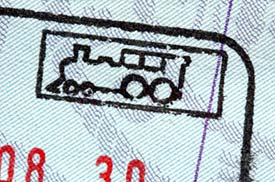
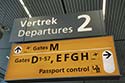
ABOVE: When you arrive from abroad, your passport stamp will indicate the mode of transportation that you used to enter the Schengen zone. INSET BELOW: A sign at Amsterdam's Schiphol Airport, and a passport-control booth.
Once you enter any of the countries that have signed the Schengen Agreement of 1985, you can cross into other countries of the Schengen zone without showing your passport. (However, police can still ask to see your papers when you're in a country, and local laws governing residency and work permits still apply.) As a practical matter, the Schengen Agreement means that you can save time when going from country to country within the Schengen zone, and--if you're from a country whose citizens require visas in Europe--a single "Schengen Visa" will let you travel freely within the zone's 25 countries up to 90 days. Countries in the Schenzen Area:Most countries in the Schengen zone belong to the European Union, but some (such as Switzerland) are from outside the EU. What's more, some countries that are in the EU (such as Britain) aren't part of the Schengen area. This means that, for example, you'll need to go through passport control if you're going from Glasgow to Amsterdam by air or from Paris to London on Eurostar. As of January, 2014, the 25 fully-implemented members of the Schengen zone included Austria, Belgium, Croatia, the Czech Republic, Denmark, Estonia, Finland, France, Germany, Greece, Hungary, Iceland, Italy, Latvia, Lithuania, Luxembourg, Malta, the Netherlands, Norway (excluding Svalbard), Poland, Portugal, Slovakia, Slovenia, Spain, Sweden, and Switzerland. For details, see the links on page 2 of this article. What to expect on arrival:
Customs regulations may also apply: Between EU countries, there's no need to make a customs declaration, but not all Schengen countries belong to the EU. If you're in an airport or ferry terminal, just follow the exit signs, which will take you through customs if necessary. Use the red customs line if you have foreign purchases to declare, or the green line if you don't. Schengen Web links:
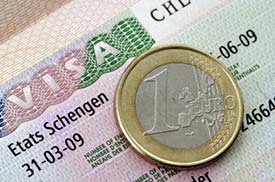
ABOVE: A Schengen visa and a euro coin.
Wikipedia: Schengen Area Schengen Visa:The Schengen Visa is a tourist and business visa. It allows travel in Schengen countries for up to 90 days within a 180-day (six-month) period, but it does not allow you to become a resident or get a job. Do you need a visa to enter the Schengen area (or the EU, for that matter) as a tourist? That depends on your nationality. See the European Commission's page on which countries' nationals require a visa to enter the Schengen area.
About the author:
After 4-1/2 years of covering European travel topics for About.com, Durant and Cheryl Imboden co-founded Europe for Visitors in 2001. The site has earned "Best of the Web" honors from Forbes and The Washington Post. For more information, see About Europe for Visitors, press clippings, and reader testimonials. Top photo copyright © Brandon
Laufenberg. |
|
|
| Europe for Visitors - Home | | About us | | Press clippings | | Testimonials | Disclosure: Where hotel or other reservation links point to third-party booking sites, we may receive a small commission on transactions. This will not affect the rate you pay. Copyright © 1996-2026 Durant and Cheryl Imboden. All rights reserved. |