| Germany Index | Europe for Visitors |
 "Best
of the Web" - Washington Post
"Best
of the Web" - Washington Post
"Best
of the Web" - Washington Post
|
|
Freiberg CathedralDom St. Marien - St. Mary's Collegiate ChurchFrom: Freiberg, Saxony
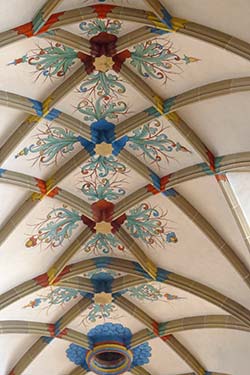
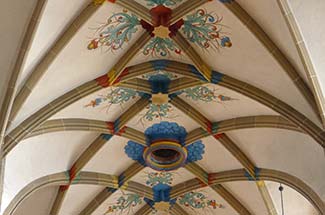
ABOVE: The flowers on the ceiling of the Dom St. Marien aren't modern additions: They're restorations of paintings from 500 years ago.
Freiberg, Germany's Dom St. Marien (in English, St. Mary's Cathedral) is a remarkable structure for a town of 40,000 people: The Late Gothic church would be the envy of many larger cities, and its artistic riches are a legacy of the town's 700 years as "the Silver City of Saxony."
Just four years after earning cathedral status, the church collapsed in a city fire that destroyed most of Freiberg. It was rebuilt in late Gothic style between 1484 and 1501, creating the Dom St. Marien that exists today. The Reformation reached Freiberg in 1537, and the church has been Protestant ever since.
You can learn more about Freiberg's St. Marien Cathedral at the church's official Web site, www.freiberger-dom.de. More photos
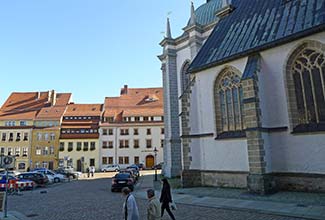
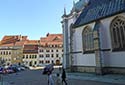
The Dom St. Marien faces the Untermarkt, or Lower Market, in Freiberg's medieval town center.
Here's another view of the Dom St. Marien's ceiling, which was restored after remnants of the original flower paintings were discovered in 1956. (The ceiling is 20 meters or 66 feet above the cathedral's floor.)
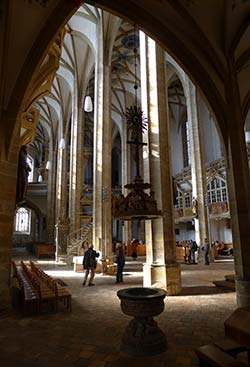
This photo of the cathedral's interior shows the columns and ribbed vaulting of the Large Hall.
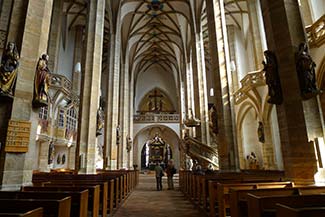
The columns of the Large Hall are decorated with statues of the "Ten Virgins" from a biblical parable about the return of Christ.
The statues are made of limewood and were carved by local artists between 1510
and 1520.
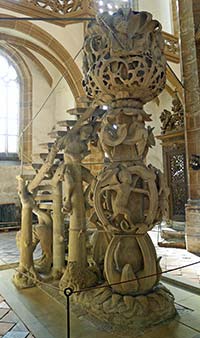
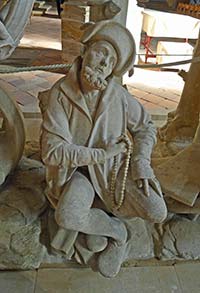
The "Tulip Pulpit" was carved in 1505. The carved figure at the base of the stairs (below) is probably the unknown person who donated the pulpit to the cathedral.
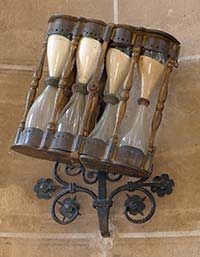
Hourglasses on the cathedral's wall were probably used to keep priests and pastors from wearing our their welcome with parishioners.
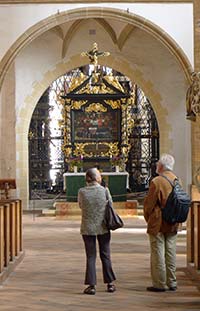
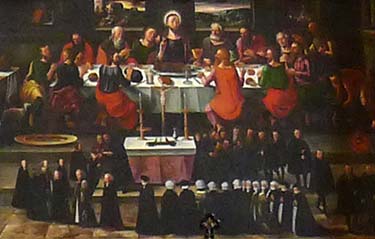
Near the front of the main aisle, tourists admire the altar and its painting of the Last Supper (below), which has two groups of figures: Christ and his disciples sharing bread and wine, and citizens of Freiberg taking communion.
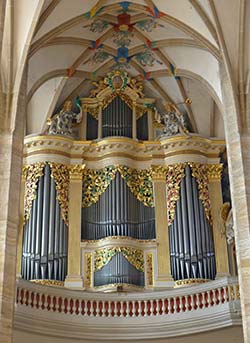
At the opposite end of the cathedral, the Great Organ by Gottfried Silbermann faces the altar. Silbermann's studio produced 46 organs from 1710 to 1753, along with large numbers of clavichords, harpsichords, and fortepianos. The organ above is the largest remaining organ by Gottfried Silbermann: It has three manuals plus pedal, 44 stops, 2,674 speaking pipes (including 113 wooden pipes), and 50 dummy pipes. The organ was built in 1714 and modified by Silbermann in 1738.
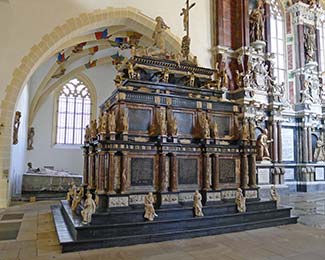
No cathedral is complete without dead people for decoration. In Freiberg Cathedral, the tomb of Moritz the Elector, a.k.a. Elector Moritz von Sachsen, has pride of place among the resident coffins. The elector was born in 1521 and died young in 1553; his marble tomb was built by Antonius Van Zorroen of Antwerp in 1563, a decade after its occupant's death. The entire area behind the altar is a funeral chapel for the Wettiner family, who were ancestors of Dresden's August der Starke or Augustus the Strong.
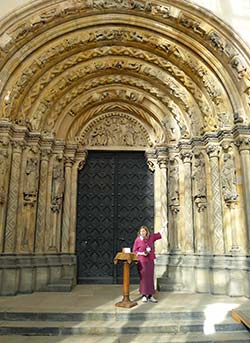
To the right of the altar is an exit that leads to the Goldene Pforte or Golden Portal, which was the main arch of the Romanesque basilica that preceded the Late Gothic cathedral. The portal was built around 1230 A.D. and is one of the few remnants of the original church, which was destroyed by fire in 1484.
About the author:
After 4-1/2 years of covering European travel topics for About.com, Durant and Cheryl Imboden co-founded Europe for Visitors (now including Germany for Visitors) in 2001. The site has earned "Best of the Web" honors from Forbes and The Washington Post. For more information, see About Europe for Visitors, press clippings, and reader testimonials. |
|
|
| Germany for Visitors - Home | | Europe for Visitors - Home | | About us | | Press clippings | | Testimonials | Copyright © 1996-2024 Durant and Cheryl Imboden. All rights reserved. |
 The church was founded in the 12th Century, when a Romanesque
basilica was erected in the town that had been founded only a few decades
earlier. (Freiberg officially became a town in 1186, and the church was built
between 1180 and 1190.) In 1386, the church was enlarged, and it became a
cathedral in 1480.
The church was founded in the 12th Century, when a Romanesque
basilica was erected in the town that had been founded only a few decades
earlier. (Freiberg officially became a town in 1186, and the church was built
between 1180 and 1190.) In 1386, the church was enlarged, and it became a
cathedral in 1480.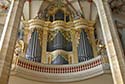 In addition to being a place of worship, the Dom St.
Marien is the final resting place for Duke Moritz (an Elector of Saxony). It
houses two organs by
In addition to being a place of worship, the Dom St.
Marien is the final resting place for Duke Moritz (an Elector of Saxony). It
houses two organs by