|
| Venice Home | All topics |
| Where to stay | Transportation |
 Helping
30+ million
Venice travelers since 1997
Helping
30+ million
Venice travelers since 1997

Helping
30+ million
Venice travelers since 1997
|
|
Bottega del Tintoretto
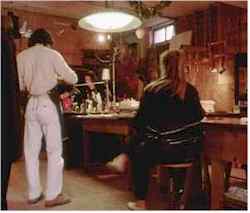
ABOVE: Roberto Mazzetto, director of the Bottega del Tintoretto, demonstrates printmaking techniques. In the 1500s, the Venetian artist Jacopo Robusti--better known as Tintoretto--operated a printmaking laboratory in the ground floor of his house on the Fondamenta dei Mori in Cannaregio, a few blocks from his parish church of Madonna dell'Orto. In 1985, master printer Roberto Mazzetto converted Tintoretto's former workshop back into a graphics workshop, and the Bottega del Tintoretto continues to serve as a cooperative laboratorio for Venetian and foreign artists more than a quarter of a century later. The Bottega--also known as the Stamperia del Tintoretto--is outfitted for lithography, etching, relief, and silkscreen printing, using antique equipment that has been restored under the direction of Signor Mazzetto. Artists can create their own editions with help from Signor Mazzetto, or they can turn their designs over to the master printer and his volunteer staff for printing. (Many of the Bottega's 60 professional members choose the latter.) The shop will also provide bound editions for artists, school classes, and other clients. Take a course or bring a classIn addition to serving as a workshop for artists, the Bottega del Tintoretto offers courses in printmaking, bookbinding, papermaking, typography, watercolor, fresco, mosaic, and sculpture. Some classes are taught one day a week from October through April. Others are intensive five-day seminars in disciplines such as traditional print techniques, lithography, experimental printing, and relief printing (e.g., woodcut). Academic groups are also welcome. The ideal class size is 10 students, although up to 15 students can be squeezed into the shop. Teaching is most efficient when the students know Italian or bring an interpreter, but an English-speaking staff member is usually on hand.
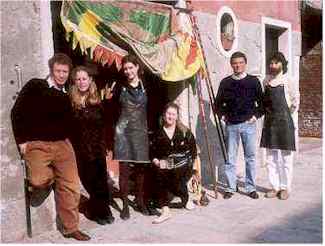
ABOVE: This archived photo shows staff member Florence Faval of Geneva (second from left), art student Ann Aspinwall of New York (third from left), and director Roberto Mazzetto (far right). Juli Van Zyverden, a longtime American resident of Venice, is seated by the workshop doorway. Practical information The Bottega del Tinoretto's hours are 10 a.m. to 1 p.m. and 2 p.m. to 5 p.m., Monday to Saturday. Students should register at least two weeks before the beginning of a course. If students or visiting artists don't have accommodations, the Bottega can arrange for rooms at a B&B in the neighborhood. For more information in Italian,, visit the Bottega del Tintoretto Web site. Or contact: Roberto Mazzetto
|
|
|
| Venice for Visitors - Home | | Europe for Visitors - Home | | About our site | | Press clippings | | Testimonials |
Disclosure: Where hotel or other reservation links point to third-party booking sites, we may receive a small commission on transactions. This will not affect the rate you pay. Copyright © 1996-2026 Durant and Cheryl Imboden. All rights reserved. |